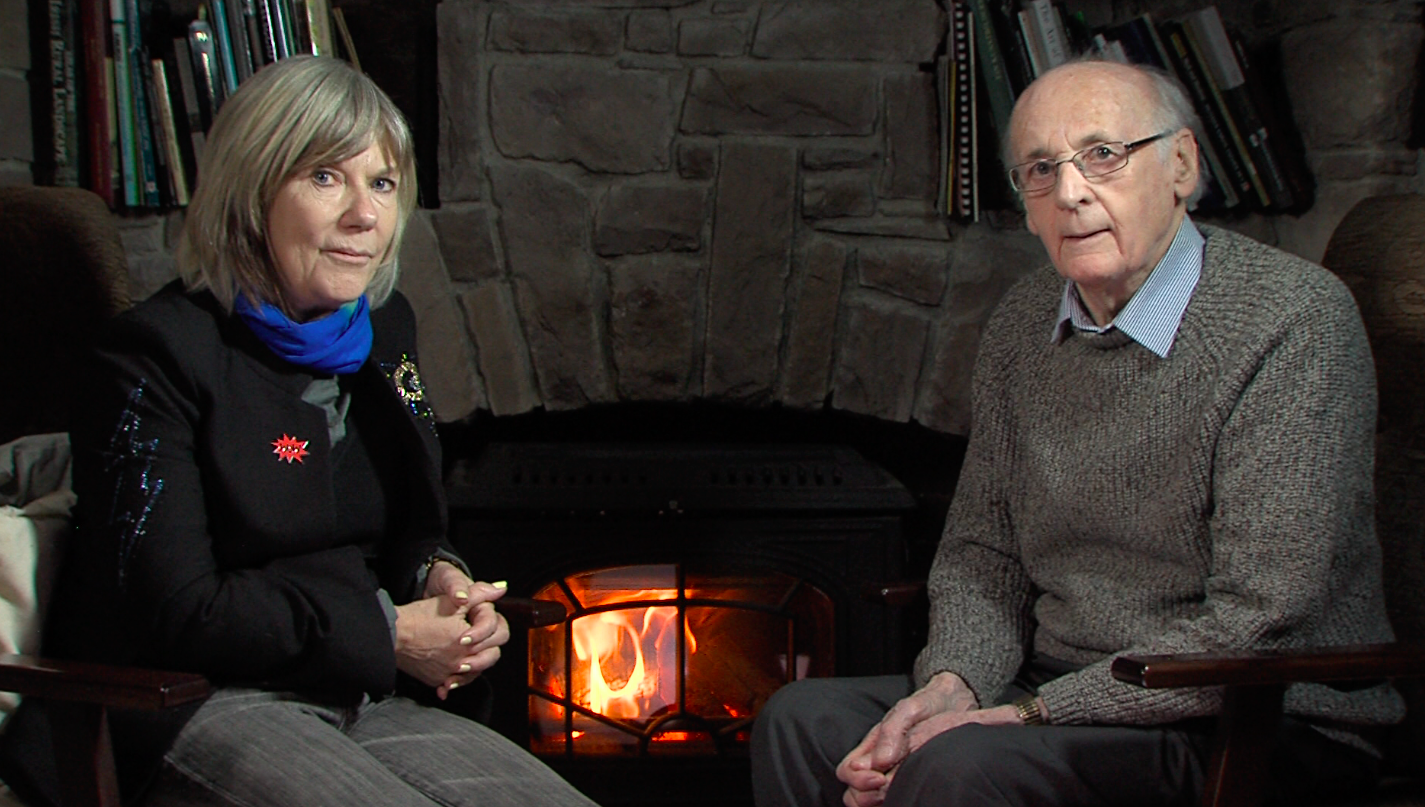
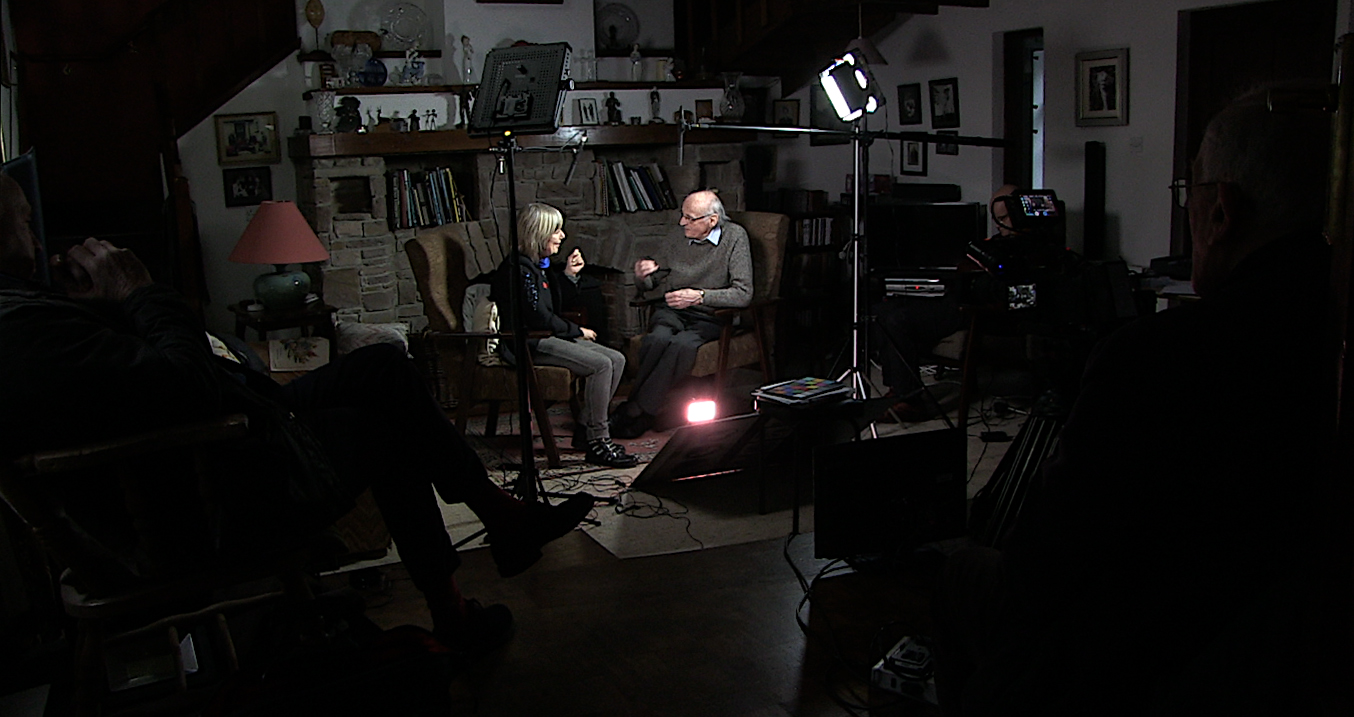
Jude Kelly, founder of Women of the World Festival (WOW) and Pat Ahern, founder of Siamsa Tíre, the National Folk Theatre of Ireland (Photo: Ciarán Walsh)
Pat Ahern and I have started recording a long conversation about the building of a state of the art theatre in Tralee, which opened in 1991 with the performance of a folk theatre manifesto that was devised and directed by Pat.
We have taken the name of that show – Forging the Dance – as a working theme for an ethnographic study of a group of people who developed a style of folk theatre over three decades, building a complex infrastructure that was designed to (a) sustain a tradition of song, music and dance related to folklife and custom in rural Ireland and (b) create a repertoire of folk theatre that captured the spirit of farming communities in culturally distinct districts.
Justin Walsh in the forge on the set of Ding Dong Dedero, Forging the Dance, 1991.
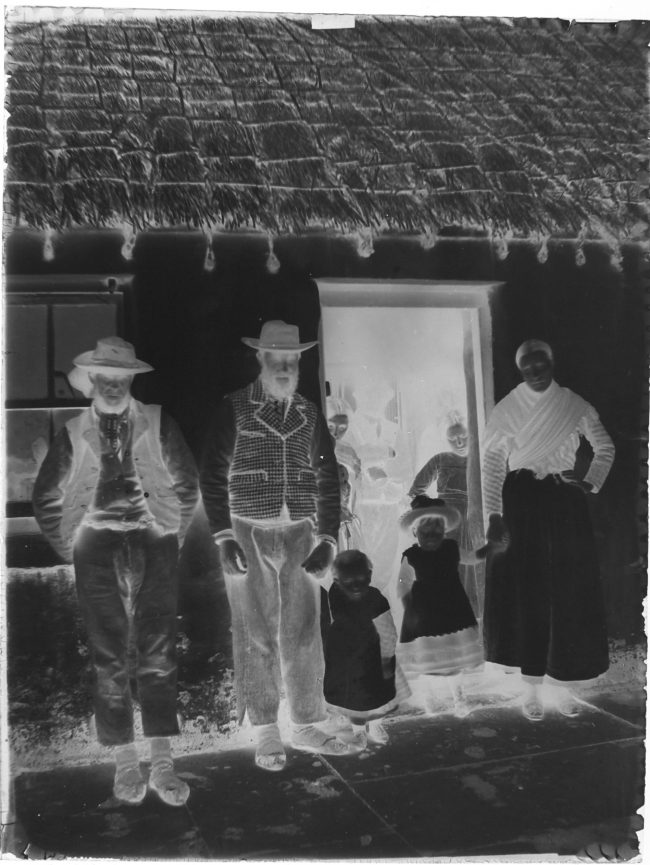
Pat Ahern aged around two. He is wearing a cóta beag, the traditional petticoat worn by young boys in the west of Ireland. His mother Maggie is standing in the doorway.
The recordings are designed to complement a personal archive that Pat has assembled and University College Cork (UCC) has digitised. So far the conversations have tracked the development of a form of folk theatre that was closely related to the rhythms and sounds of life in a small, farming community in North Kerry.
As a small boy, his mother took Pat to see a travelling theatre company in the local village hall. The experience triggered a fascination with theatrical form and he began to produce plays with his siblings and neighbours’ children in a hay-shed on the family farm. This was the beginning of a folk theatre movement that became the National Folk Theatre of Ireland and culminated in the construction of the first new-build theatre in the history of the state.
The construction of the new home of the National Folk Theatre in Tralee. The theatre and arts centre opened in 1991. Pat Ahern and Liam Tarrant dancing at the opening of the Teach Siamsa Training Centre in Finuge in 1974 (Still from a film of the opening that has been posted online by Paul Kennelly).
Along the way we have explored the development of a theatre company in a former cinema in Tralee and the construction of training centres in north and west Kerry; in townlands where traditional music, song and dance were strong. As Pat puts it: “We went north for the dance and west for the language.” The idea was that these centres would keep the theatre rooted in vibrant and distinct folk cultures and communities.
Jude Kellycame to Ireland in 1975 as a student of drama in search of a new form of storytelling. She heard about the folk movement in Kerry and visited Pat in Finuge. She was profoundly influenced by the community-based, theatrical form he was developing in the training centres and presenting on stage in Tralee.
She met up with Pat again last Friday (February 14, 2020) and we recorded a long conversation about identity, folk, and theatre practice. It was the first of many such conversations that will tell story of the people who built a theatre in Tralee, a sort of long-format ethnographic study of the folk of North Kerry that will be delivered online (details to be announced).
In the meantime, the plan is to produce a short-form documentary, developing a story that was begun by Dermod McCarthy’s in Bímís ag Rinnce – Let us Dance, the 1975 Radharc Film that is listed in the British Film Institute (BFI) archive.
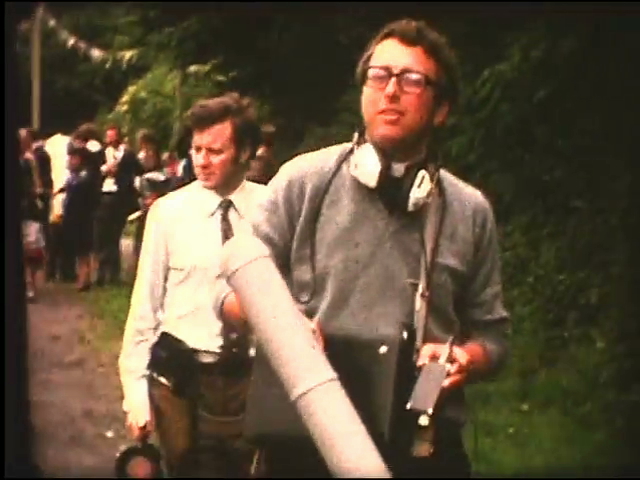
Paddy White performing at the opening of Teach Siamsa Finuge in 1974. Paddy used the chairs for support while he danced, but even so, he was the best exponent of the North Kerry style of dance developed by Jerry Molyneaux. Martin Whelan, the first General Manager of the National Folk Theatre, is standing in the background (Stills from A Radharc Film directed by Dermod McCarthy and filmed by Brian O’Reilly)Still from a film posted online by Paul Kennelly
www.curator.ie in the field: Peadar Mór Ó Conghaile, Ciarán Walsh and Muiris Ó Conghaile taking a break during filming on Inis Meáin.
Do Haddon’s photographs of the Aran Islands change the history of anthropology as we know it?
I will put this question to historians of anthropology at a major conference in Lisbon in July 2020, when I present my research in a paper on Old Tropes / New Histories: an “Irish” reading of Haddon’s ethnographies.
I make the bold claim that the social-documentary approach to photography that Haddon adopted in his ethnographic studies of the Aran Islands represents the roll-out of an innovative, visual anthropology that he developed as a vehicle for anti-colonial activism in the 1890s.
That fits the theme of the 16th Biennial Conference of the European Association of Social Anthropologists (EASA). The conference will consider ‘such social, political, material and cultural currents in and beyond Europe, covering both the academic and ethnographic locations in which anthropologists work, in order to consider the ethical, political and intellectual challenges to anthropology that they pose.’
Thomas Fitzpatrick, 1894, Arran Isles. Weekly Freeman & National Press, April 21. See L. Perry Curtis’s book on The Depiction of Eviction in Ireland 1845-1910 (Fig. 38), which was published by UCD Press (University College Dublin) in 2011.
My paper addresses the sub-theme of imperial, colonial, and decolonial relations and legacies: taking the symbolic importance of the Aran Islands in the political campaign for home rule – decolonisation – in the 1890s as a starting point and projecting forward to the capacity of anthropologists to respond meaningfully to the contemporary challenges posed by climate change, habitation destruction, colonisation, forced migration, and genocide.
This builds on the work that a group of us will be doing at the Anthropology and Geography Conference in London in June 2020, but this paper is more historical in focus. It will be presented at a session that has been convened by the History of Anthropology Networkto reassess ‘in creative ways ethnographic works produced by observers of the late 19th and early 20th centuries, whose writings may regain importance in the eclectic futures of the discipline.’
I will make the case that Haddon’s photographs are full of surprises, some of which raise awkward questions about the history of anthropology. What if, for instance, some of the tropes generated by historicists who framed the history of anthropology before Malinowski – whose Argonauts of the Western Pacific (1922) is generally regarded as marking the start of modern anthropology – are based on a misreading of the archive?”
Haddon took two photographs of Michael Faherty and two women from Inis Meáin (Inishmaan) in 1892, noting in The Ethnography of the Aran Islands, County Galway that that ‘Faherty refused to be measured, and the women would not even tell us their names.’ Nevertheless, they posed for two photographs and flicking between the two, one gets some sense of the nature of the engagement between the photographer and the islanders, which is very different from the sort of colonial encounter described by most historians of the history of photography in anthropology. (Courtesy of the Board of Trinity College Dublin).
My focus is on Haddon and his experimental ethnographic practice in Ireland in the first half of the 1890s. I will argue that a generation of historians of anthropology have misinterpreted Haddon’s fieldwork in Ireland, presenting as evidence an “Irish” reading of Haddon’s photographs, journals, and correspondence relating to his travels in the west of Ireland between 1890 and 1895. This is a novel vantage point from which the history of Anglo-Irish anthropology looks very, very different.
From this perspective, Haddon’s “Irish” ethnographies look like a synthesis of anarchist geography, newly developed social survey methods, and a radical attitude to village communalism: rather than the preoccupation with race, bracketed by evolution and colonialism, that sustains some well-established tropes in the historiography of anthropology.
Furthermore, I will argue that Haddon’s ethnographies have to be “seen” in the context of decolonisation in Ireland in the 1890s, making the case that Haddon’s photo-ethnographic practice was an innovative form of anti-imperial activism that emerged from a long tradition of humanitarian activism in 19th century anthropology.
That, I will propose, amounts to a more nuanced history of anthropology, which remains utterly relevant as anthropologists – practical and academic – contemplate the challenges posed by globalisation and accelerating climate change.
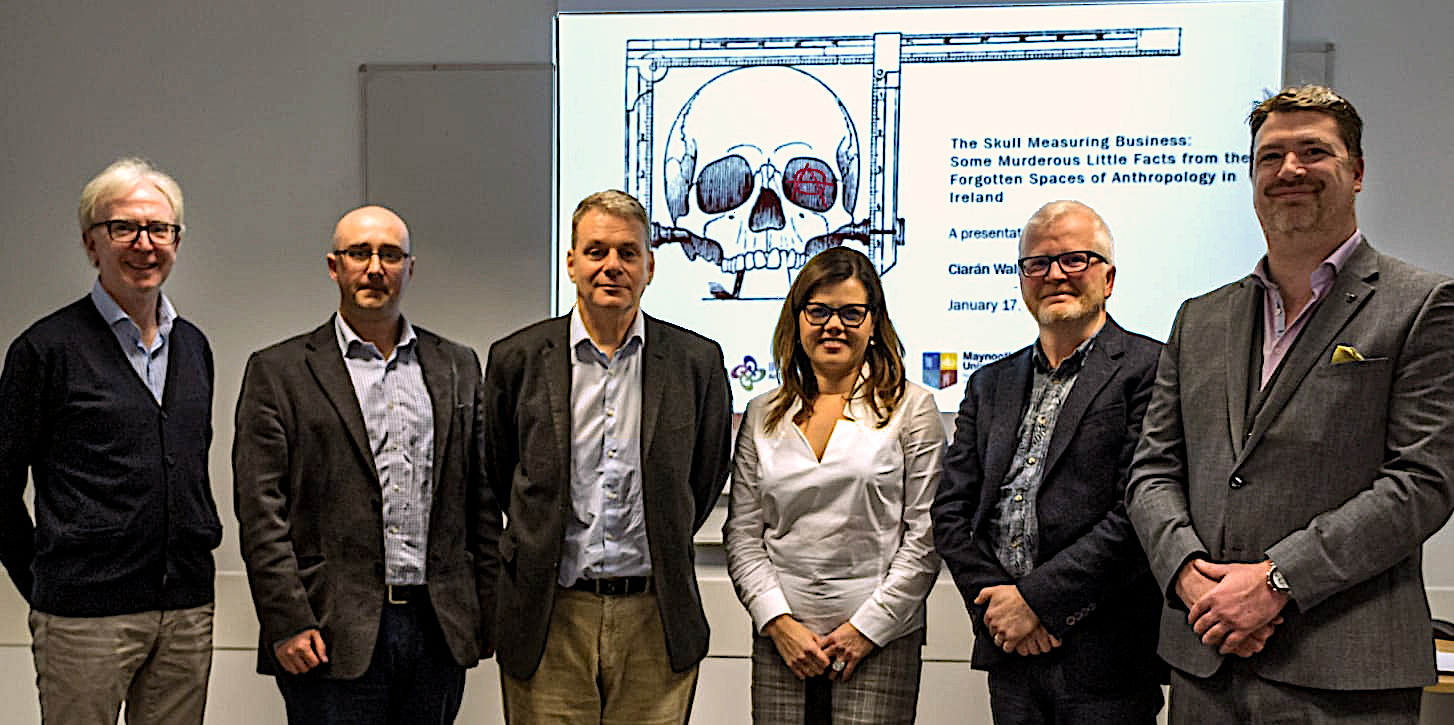
Last Friday, I became an anthropologist after I successfully defended my PhD thesis at Maynooth University (MU), where I made a short presentation about my research on the skull measuring business in Ireland and answered questions from a panel of experts who were appointed to assess the quality of my research and the arguments presented in my thesis.
Dr David Shankland, Director of the Royal Anthropological Institute in London, agreed to act as external examiner when I submitted my thesis in October 2019. He described it as an excellent piece of research, which, if grades were given for a PhD, would have achieved the grade of summa cum laude, with the highest distinction.
Prof Hana Červinková, Head of the Dept of Anthropology at MU, agreed to act as an internal examiner. She led an interesting discussion of the relationship between my work as a visual arts curator and an anthropologist, which revealed the extent to which a brief exposure to anthropology in art college in the 1980s had a profound influence on my work as a curator ever since. It was at that point in the discussion that I realised that I had become an anthropologist.
Dr. Thomas Flavin agreed to chair the examination and Dr Mark Maguire and Prof David Prendergast, my supervisors, attended as observers, as is the practice on these occasions. Prof Martina Hennessy represented TCD School of Medicine, which is a research partner in this project.
L-R: Chair Dr. Thomas Flavin (Associate Professor, Economics, Finance and Accounting, MU), Supervisor Prof David Prendergast (Dept of Anthropology MU), external examiner Dr David Shankland (Director, Royal Anthropological Institute, London), internal examiner Prof Hana Červinková (Head of Dept of Anthropology, MU), Ciarán Walsh, IRC Scholar, and supervisor Dr Mark Maguire (Dean of the Faculty of Social Sciences, MU).
The panel decided that I should be awarded a Doctorate degree without further examination, subject to making the changes specified to the satisfaction of my internal examiner, a process that should take a couple of weeks. Then I submit hardbound copies of my thesis and I become a Doctor of Philosophy (Anthropology) at a conferring ceremony in Maynooth University in September 2020.
Acknowledgements
My thesis represents the culmination of groundbreaking and critically acclaimed work on John Millington’s Synge’s ethnographic photography, which was developed in the “Irish Headhunter” project with co-curator Dáithí De Mórdha. This led into this study of the skull measuring business and the associated development by Alfred Cort Haddon of an early form of modern visual ethnography in the west of Ireland in the 1890s. This project was truly collaborative and would not have been possible without the support of many people in Dublin, Cambridge, London, and, of course, Ballyheigue.
There isn’t enough space to acknowledge individual contributions here, but I do want to acknowledge the support – financial and otherwise – of the Irish Research Council and Shanahan Research Group over a period of almost 5 years. With regard to the academic programme, I acknowledge the generosity of everyone in Cambridge University Library, Cambridge UniversityMuseum of Archaeology and Anthropology, the Haddon Library, Trinity College Dublin, and the support, hard work, patience, and perseverance of everyone in the Anthropology Department at Maynooth University.
“They didn’t manage to kill us all at the time of colonization” says Celia Xakriabá “but we are living through a moment of legislated genocide.” Xakriabá is an activist who is featured in Tribal Voice,an online campaign that is organised by Survival International.
Confronting Genocide
Anthropology and Geography Conference, London June 4-7, 2020.
How do we deal with the threat of genocide in 2020?
“We” are a group of researchers, academics, and environmental activists who are responding to the humanitarian consequences of unprecedented and accelerated deforestation in the Amazon, which raises the issue of genocide in Brazil and other countries across the globe.
The burning of the Amazon rainforest in Mato Grosso state, Brazil. Photo: Mayke Toscano/AFP/Getty Images & The Guardian
In keeping with the conference theme of “dialogues past, present and future,” we are asking if we have learned anything from over 150 years of genocide and humanitarian activism in response to it. For instance, in the 1890s, a small group of anthropologists and geographers went against the colonial mainstream and demanded a radical political response from the scientific community and the public to the threat of genocide created by habitat destruction by colonists.
It sounds very historical, but Celia Xakriabá (see above ) makes it clear that the threat of genocide is very real, very current and the call to action is even more urgent today given the situation that is developing in the Amazon under Bolsonaro, whose policies have been described as “legislated genocide.”
The indigenous peoples of the Amazon are not the only populations under threat and Brazil is not the only place where a combination of globalisation and habitat destruction is leading to “legislated genocide”-–the deliberate destruction of livelihoods and the legalised murder of indigenous peoples. Genocide is happening now in Turkey, the Kalahari, the Congo Basin, the jungles of India, the Andaman Islands, Australasia.
Mohammad Salas, a 51-year-old man from Iran’s largest Sufi order, the Gonabadi Dervish religious minority. Salas was executed by the Iranian authorities after a trial that was widely condemned as a miscarriage of justice. Amnesty International.
Much of this genocide has remained hidden and we hope that our research and activism will start a debate about “legislated genocide,” a combination of advocacy and activism that will encourage further action in solidarity with the victims of habitat destruction, forced migration, and genocide, whether the causes are cultural, political, economic, or environmental.
The Contributors
The debate will be chaired by DrEve Bratman, Assistant Professor of Environmental Studies at Franklin & Marshall College. She will give a paper on “The Lives and Landscapes of Sustainable Development in the Xingu River Basin of the Brazilian Amazon.” She asks how the discourse of sustainable development legitimates and privileges certain interests, and how it comes to be manifested – and resisted. She will present as a case study the geographic and social terrain of the Xingu river basin in the state of Pará. Oxford University Press has just published her book Governing the Rainforest: Sustainable Development Politics in the Brazilian Amazon.
Representatives of the local indigenous communities and environmental activists demonstrate in Sao Paulo against the construction of Belo Monte dam at Xingu river in the Brazilian state of Para. Photograph: Yasuyoshi Chiba/AFP/Getty Images (The Guardian).
Fiona Watson, Advocacy and Research Director with Survival international, will present Tribal Voice, a series of hard-hitting videos that provide an online platform for tribal peoples living in an age of legislated genocide. These videos expose hidden genocides and support tribal peoples in their fight against genocide. Tribal Voice represents a significant development in the nature and direction of humanitarian activism and has profound implications for the idea of engaged practices in a multi-agency fight against legislated genocide in 2020 and beyond. Watson is a regular contributor to The Guardian.
Dr Raúl Acosta-Garcia, Institut für Ethnologie, Ludwig-Maximilians-Universität Munich, will deal with advocacy networks that have sought to protect the Amazon rainforest and its inhabitants, creating associations that have become laboratories for political experimentation. His analysis builds on arguments presented in his new book Civil becomings: performative politics in the Brazilian Amazon and the Mediterranean, the first monograph of the series NGOgraphies (University of Alabama Press).
Top: An aerial view of the road BR-319 highway near city of Humaita, Amazonas state, Brazil (Irish Examiner). Bottom: A paved section of the BR-163 highway in Brazil. (Photo by Jeso Carneiro/Flickr / Eve Bratman & NACLA)
Dr Federico Ferretti,Associate Professor, University College Dublin, School of Geography, will present a paper on “Savage anarchy’ between geography and anthropology”, which deals with early forms of collaboration that occurred between geographical and anthropological (or ethnographical) knowledge around the circuits of anarchist geographers between the nineteenth and the twentieth century. Ferretti is the invited author for the Progress in Human Geography report series on ‘History and Philosophy of Geography‘ from 2020 to 2022 (3 papers).
A detail of a photograph taken by Alfred Cort Haddon in the Torres Strait in 1888 and a detail from a Tribal Voice video released by Survival International in 2019
Ciarán Walsh, freelance curator, will deal with the emergence of social anthropology from radical geography in Ireland in the 1890s, using the photo-ethnographic practice of Alfred Cort Haddon as a novel vantage point from which to see how anthropology is positioned to deal with climate change, the destruction of habitats, and hostile borders in the present and assess the future relevance of the discipline in this context.His essay on “Anarchy in the UK: Haddon and the anarchist agenda in the Anglo-Irish folklore movement” is about to go to press (Routledge).
The discussant isDr Matthew Cheeseman,Associate Professor of Creative Writing, College of Arts, Humanities and Education, University of Derby, who is working with Carina Hart of the University of Nottingham on a collection of essays (Routledge) dealing with the relationship between nationality, identity, and folklore movements in the context of Brexit and the rise of the alt right in Europe.
The Anthropology and Geography: Dialogues Past, Present and Future conference is jointly organised by the Royal Anthropological Institute of Great Britain and Ireland, the Royal Geographical Society, the British Academy, the Department of Anthropology and Sociology at SOAS (The School of Oriental & African Studies), and the British Museum’s Department for Africa, Oceania and the Americas. The conference will be held in SOAS, Senate House, and the Clore Centre of the British Museum.
L-R: Prof David Prendergast and Ciarán Walsh, Dept of Anthropology, and Dr Mark Maguire, Dean of Social Sciences, with a copy of the thesis Walsh submitted as the first stage in the completion of a 4 year research project that was funded by the Irish Research Council and Shanahan Research Group (photo: Jamie Saris)..
Ciarán Walsh|www.curator.ie has submitted a thesis in partial fulfilment of a PhD at Maynooth University, the next stage being a defence of his research and findings. The thesis represents the culmination of a ten year investigation of the photographic archive of the Irish Ethnographic Survey, which was active in the West of Ireland between 1891 and 1890.
The project took place in two phases. The first phase, the Irish “Headhunter” Project was a collaboration with Dáithí de Mórdha and involved an exhibition of photographs drawn from a set of albums that were compiled by Charles R. Browne in 1897 and donated to TCD 100 years later. The photographs had never been shown in public and attracted a lot of attention from the anthropological community in Ireland.
Mark Maguire, Ciarán Walsh , Nicola Reynolds and Steve Coleman at the launch of the Irish “Headhunter” Project in Maynooth University in 2013.
The discovery of important new material in Cambridge and Dublin in 2013 and 2014 opened the way for a second phase, an intensive four-year investigation of the skull measuring business in Ireland in the 1890s. The research was funded by the Irish Research Council and Shanahan Research Group and managed by Maynooth University in partnership with TCD School of Medicine. The focus shifted from physical anthropology–the skull measuring business–to the role of photography in a politically radical and formally innovative social documentary project launched by Alfred Cort Haddon in the Aran Islands in 1890.
The thesis is titled “The Skull Measuring Business,” a phrase that resonates with a particular view of Victorian anthropology as practised in Ireland in the 1890s. It captures perfectly the idea of English scientists travelling to the periphery of the United Kingdom to trace the racial origins of the “native” Irish at the height of the home rule crisis.
Indeed, Patrick Geddes, the bio-social innovator, coined the phrase to describe a restricted form of Anglo-French anthropology that has become inextricably linked to eugenics, the theoretical precursor of scientific racism. Geddes was warning Haddon that a radical approach to social organisation represented the future of anthropology. This study attempts to find out how Haddon responded, in view of the fact that he was photographed measuring skulls in the Aran Islands in 1892. It builds upon the discovery in 2013 and 2014 of “lost” documentary and photographic material in Dublin and Cambridge.
This triggered a review–an “Irish” reading–of Haddon’s papers, concentrating on mostly uncatalogued material relating to his experimental ethnographical surveys of ethnical islands in the west of Ireland. It became clear that the facts uncovered contradict conventional accounts of the skull measuring business; narratives that are usually structured around evolution, race, and imperialism. Instead, Haddon emerges as an English radical and supporter of home rule. He built a network of folklore collectors that constituted an anti-imperial, Anglo-Irish folklore movement, which was aligned with the cultural programme of Douglas Hyde. That has been forgotten, overlooked, or misinterpreted.
Furthermore, Haddon preferred photography to text and his use of the magic lantern as an instrument of anti-colonial activism represents a singular modernist achievement in anthropology. Ironically, this has remained invisible to many historians of disciplinary anthropology. This thesis attempts to correct this by killing some anthropological tropes and creating space for alternative narratives.