
About
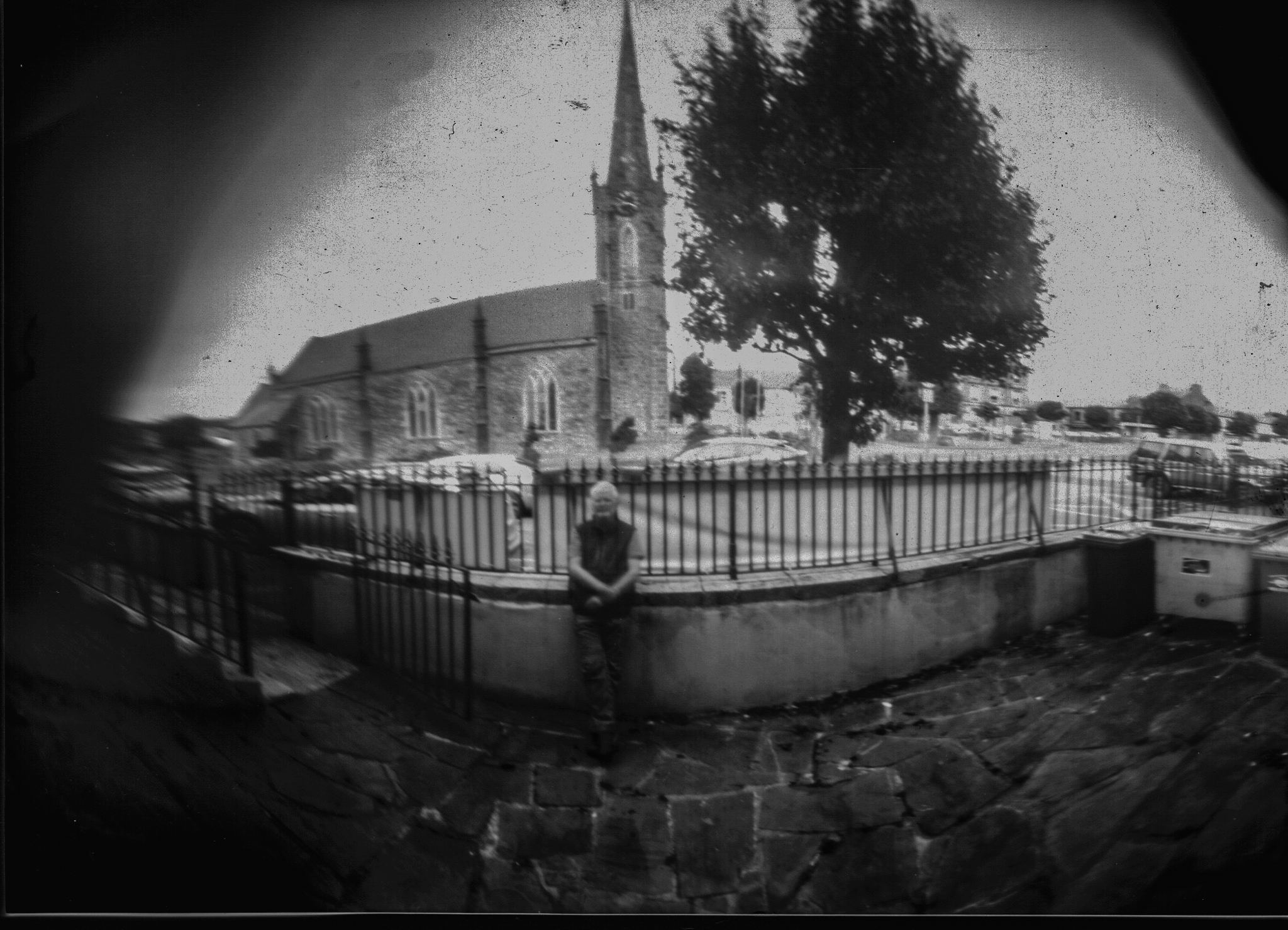
Ciarán Walsh, 2024, Self portrait with pinhole camera shot during a workshop Harry Moore led for Heritage Week 2024.
Page updated 20|05| 2026
I was born in Newry in the middle of the 1950s Border Campaign. I grew up in Cork and moved to Dublin in 1977 to take up a job in the Dept of Justice. I resigned after four years and joined the National College of Art and Design, where I specialised in arts activism in the form of a full-time arts education degree course.
For the next ten years I worked in various arts education contexts, becoming the first education officer in an art centre in 1989 before joining the Arts Council as Education Officer. I went back to the field in 1995 when I took on the job of Visual Arts Director of the National Folk Theatre in Kerry. It was a temporary move that became more or less permanent. In 2007, I went on honeymoon to Inis Meáin and learned about John Millington Synge’s work as a photographer.
That changed everything. I had always been interested in social documentary photography as part of an art activists’s toolkit, but finding Synge became the inspiration for curator.ie. I left the National Folk Theatre in 2010 and have worked as a freelance curator ever since.
Some context
For as long as I can remember I wanted to go to art college when I finished school, but that was never an option. Art was not taught in school. so I attended evening classes at Crawford School of Art in Cork instead. Otherwise, I barely got through secondary school and was kicked out of Common Science in UCC after a term.
Working at the Dept of Justice gave me an opportunity to return to third level education on a part-time basis and try out various options. I chose education and graduated with a BA in Art and Design Education in 1984. I completed a HETAC Masters by Research in 2008, which took the form of a search for an indigenous visual tradition equivalent to the vibrant folk scene that emerged in the 1960s and 1970s. Remember Shane MacGowan?
That led me to Johnny Synge and the Synge project with TCD provided the foundation for curator.ie. Since then I have curated landmark projects an extraordinary ethnographic archive that Charles R. Browne created in 1897, which developed into an extended project on Alfred Cort Haddon and his pioneering photo-ethnographic work of in the Aran Islands in 1890 and the publication of Alfred Cort Haddon, A Very English Savage(Berghahn Books, 2023). Along the way I received a PhD Cum Summa Laude in Anthropology, making me a sort of accidental anthropologist.
That work continues with an investigation of photographic network in Dublin in the 1890s, especially, the photographic collections of Andrew Francis Dixon and John Joly, who patented the first single shot colour photograph system in 1894. The effect is an incremental and radical rewrite of the history of photography in Ireland and the beauty of this is that it involves a network of photographic collectors, curators, archivists, researchers and artists.
I live near the village of Ballyheigue in the southwest of Ireland and am a mountaineer, a kayaker and an occasional cyclist.

Ciarán Walsh approaching the Great Blasket Island. Photo by Padraig O’Donoghue.
