The burning of the Amazon rainforest in Mato Grosso state, Brazil. Photo: Mayke Toscano/AFP/Getty Images & The Guardian
curator.ie is working with a group of activists and scholars to organise a debate about the capacity of anthropologists and geographers to confront genocide. We are putting together a panel for a major conference on anthropology and geography, which is scheduled to take place in London in June 2020.
Anthropology and Geography: Dialogues Past, Present and Future is being jointly organised by the Royal Anthropological Institute (RAI), the Royal Geographical Society, the British Academy, the Department of Anthropology and Sociology at SOAS (University of London), and the Department for Africa, Oceania and the Americas in the British Museum. It will run from 4 – 7 JUNE 2020.
The debate has been triggered by the current crisis in the Amazon, but the issue is as old as anthropology itself. That is where Dialogues Past, Present and Future come into play. We are asking people to consider the following:
40,000 fires burn in the Amazon, threatening the homeland of the Awá people. In the 1890s, anarcho-Solidarists demanded a radical political response from anthropologists, geographers, and sociologists to the threat of genocide through habitat destruction by colonists.
Was anyone listening?
The debate will be framed by an historical precedent from the 1890s, when Alfred Cort Haddon called on the anthropological community to stand in solidarity with the victims of imperialism. The call was taken up by a small group of humanitarians within organised anthropology, but they were forced underground.
Alfred Cort Haddon, 1892, Michael Faherty, and two women, Inishmaan. The photograph was taken during an ethnographic survey of the Aran Islands off the western coast of Ireland. Haddon commented that ‘Faherty refused to be measured, and the women would not even tell us their names.’ (Photo: Trinity College Dublin).
Haddon, undeterred, devised the phrase “vanishing knowledge” as code for the cultural consequences of genocide. The phrase has been resurrected here as a slightly ironic reminder of a time when anthropologists and geographers stood against genocide; a humanitarian insurgency that has been written out of the history of the discipline of anthropology.
Mohammad Salas, a 51-year-old man from Iran’s largest Sufi order, the Gonabadi Dervish religious minority. Salas was executed by the Iranian authorities after a trial that was widely condemned as a miscarriage of justice. Amnesty International.
The plight of the Awá is desperately topical, but it is not unique. There are many other groups whose way of life is threatened by economic, political, and cultural forces. The question here is whether anthropologists and geographers have the capacity to make a difference. That question will, in many ways, frame a debate about the future relevance of anthropology and geography.
If people want to get involved in this debate, the RAI and has issued a call for papers.
Prof David Hopkin at the Folklore and the Nation conference organised by the Folklore Society in Derby on the weekend that the UK was due to leave the EU. Photo: Ciarán Walsh.
What has folklore got to do with Brexit? That was one of the themes explored at the recent Folklore and the Nation conference in Derby, which opened on the day that the UK was due to leave the EU. The conference was convened with one eye on Brexit and the other on wider nationalist movements. It asked ‘how, why and when folklore has been deployed in the context of national ideologies and ideas of nationhood.’
I made a twenty minute presentation entitled “Leaving the Union: Haddon, Home Rule and the Anti-Imperial Agenda in Anglo-Irish Folklore.” It represented, as Haddon would said, the ‘first fruits” of a six year investigation of “the skull Measuring business” in Ireland in the 1890s.
Charles R. Browne and Alfred Cort Haddon measuring Tom Connelly during field work undertaken by the Dublin Anthropometry Laboratory in the Aran islands in 1892. Courtesy of the Board of Trinity College Dublin.
My research was funded by the Irish Research Council in partnership with Shanahan research Group, Maynooth University, and the School of Medicine TCD. It represents a major re-assessment of Haddon’s contribution to anthropology, focussing on the politically radical and formally revolutionary fieldwork undertaken by him in Ireland between 1890 and 1895.
“Leaving the Union”explored the role that folklore played in the political and cultural arguments that were generated by home rule; the campaign to take Ireland out of political and economic union with Great Britain, which dominated Anglo-Irish relations in the the 1880s and 1890s.
The White Horse in Derby 29, March 2019. Photo: Ciarán Walsh
There are some obvious parallels with Brexit. The Customs Union and a backstop for the Protestant minority [1] in Ireland featured in the first Government of Ireland or Home Rule Bill of 1886. The bill was defeated by the Conservatives supported by Unionists.
The differences are far more significant.
Ireland was a colony and the intertwined campaigns for home rule and land reform were confronted with “coercion” legislation[2] and the mobilisation of imperial forces. Cultural forces were also mobilised in a debate about the compatibility of the Celt and the Anglo-Saxon in relation to nationality and governance.
Victoria Square, Birmingham. Photo: Ciarán Walsh
Folklore collectors – the practical wing of domestic ethnology – provided evidence of a pre-conquest nation that survived in the edgelands of Empire in Ireland. This is generally treated as a resource for cultural nationalism and I was not arguing with that.
What I proposed was that there was a far more radical, anti-Imperial movement in Anglo-Irish folklore and that it was led by Haddon, the head-hunter. I presented evidence that Haddon was influenced by stateless anarchists and other radicals and that this influence shaped his approach to fieldwork in Ireland.
This turns the history of anthropology in Ireland and England on its head.
A FULL TRANSCRIPT OF THE PRESENTATION IS AVAILABLE HERE
NOTES
[1] The backstop consisted of a ban ‘on the establishment or endowment of any religious denomination’ (Shepard 1912: 565).
[2] Criminal Law and Procedure (Ireland) Act 1887 was introduced by Arthur “Bloody” Balfour, the political leader of the British Administration in Ireland.
This research was funded by the Irish Research Council in partnership with Shanahan research Group, Maynooth University, and the School of Medicine TCD
Clara Patterson’s photograph of children playing a game in Ballymiscaw, County Down, c.1894. Patterson was encouraged by Alfred Cort Haddon to document folk customs in Ireland.
Folklore, Nationalism, Home Rule, and Brexit
Ciarán Walsh will be taking part in a conference on the relation between folklore and nationalism. Folklore and the Nation is timed to coincide with the exit of the UK from the EU. It’s being organised by the Folklore Society (FLS) and hosted by the University of Derby. It kicks off on the afternoon of Friday 29 March 2019.
His paper deals with ethnicity, nationalism and folklore, drawing on a forgotten anti-imperial movement in British folklore. It begins with an anti-colonial speech delivered by Alfred Haddon in Ipswich in 1895. Haddon was aligned with the volkskunde wing of the folklore movement in Ireland and opened his speech by acknowledging nationalist efforts to disengage from political and economic union with Britain.
Haddon entered anthropology through folklore, equating the destruction of native customs in subjugated territories with the loss of personal identity, ethnicity, and, ultimately, nationhood. Haddon spoke to Patrick Geddes and Havelock Ellis about reconstituting anthropology as a vehicle for radical anti-colonial activism.
They were inspired by the anarchist geography of Kropotkin, the radical ethnology of Reclus, and the “Zeitgeist” of Gomme (FLS). This conference looks like the place to remember an engagement between Irish nationalists, English folklorists and stateless anarchists /ethnologists on the brink of Ireland’s exit from Britain.
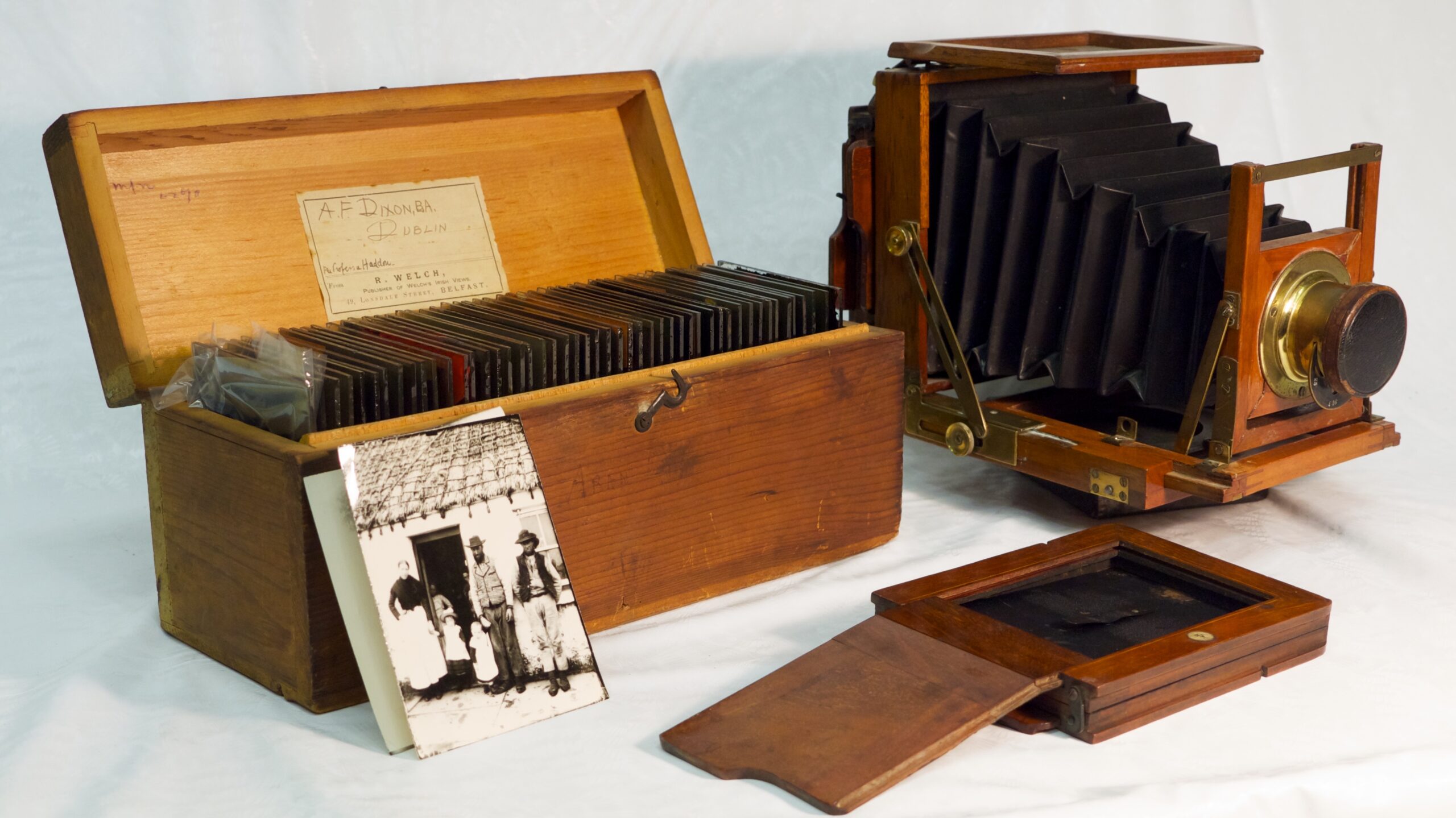
Work has begun on the conservation of a box of 50 glass plate photographic negatives exposed in the Aran Islands in 1890. Ciarán Walsh | www.curator.ie has commissioned Ciaran Rooney of Filmbank Colour Management to scan the negatives and produce a set of archive quality, exhibition-ready prints.
Rooney and Walsh worked together on the Irish “Head-hunter” project (2012) and the photographic collection of the Great Blasket Centre in Dún Chaoin (2013). This project is being undertaken in partnership with TCD School of Medicine and Maynooth university. It is funded by the Irish Research Council.
The Dixon negatives in their original, slotted storage box, a first-generation print, a negative holder and a a quarter plate camera similar to the the one used by Dixon.
The photographs were taken by Andrew Francis Dixon in 1890. Dixon was a medical student who was working as an assistant to Alfred Cort Haddon, a marine biologist, during a survey coastal of fisheries in the West of Ireland. They spent a week in the islands and recorded the mode of life of the islanders and various archaeological sites. These are the earliest ethnographic photographs of the islanders and are a very important addition to the national photographic archive.
The shelf underneath the “old” Anatomy Theatre, where the negatives were discovered in 2014.
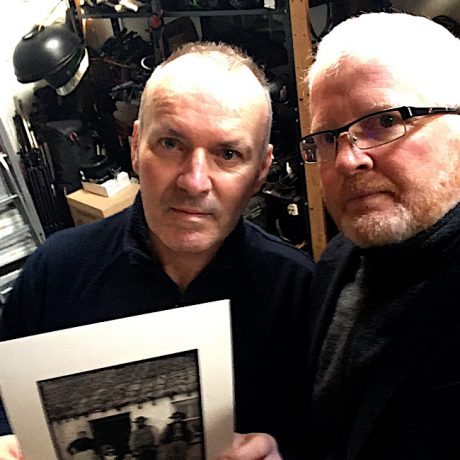
The negatives were discovered by Ciarán Walsh and Siobhán Ward in 2014, on a shelf under the decommissioned theatre in “Old” Anatomy in TCD. They became the focus of a four year research project that is funded by the Irish Research Council and involves a partnership between the school of Anthropology in Maynooth University and TCD School of Medicine.
A photograph taken in Dún Chonchubhair on Inis Meáin. The negative on the left shows the original masking carried out by R. J. Welch, a Belfast photographer who processed the negatives in 1890.
The negatives are being scanned in preparation for a publication project with Cambridge University Library.
The Go Between: Alfred Cort Haddon and a
forgotten engagement between Irish Folklore and Anarchist Ethnology.
Why did Haddon have Douglas Hyde’s name in his
“little black book”? Haddon delivered an uncompromising critique of Anglo-Saxon
colonialism at a packed meeting of the Anthropological Section of the
British Association in 1895. He equated the policy of killing Home Rule with
kindness with a fundamental misunderstanding of the nature of civilisation and
demanded that institutional anthropology consider the terrible consequences of
British Imperialism. Haddon had, in many ways, called for the urgent
de-Anglicisation of British colonies, at
home and overseas. Was he influenced by Douglas Hyde? Haddon is remembered
in disciplinary histories as an evolutionist and an exponent of “scientific”
folklore. He is popularly remembered as a “head-hunter.” This
paper proposes an alternative view; that (1) Haddon was a radical ethnologist
and (2) that his practice was shaped by an engagement with anarchist
ethnologists in Paris at the same time that he was conducting experiments in ethnological
fieldwork–collecting folklore–in the West of Ireland.
The evidence comes from recently discovered papers and other, overlooked, “Irish”
material in the Haddon Papers in Cambridge. This material relates to two
interconnected networks. The first comprised of anarchists and social reformers
in Paris, including Patrick Geddes, Havelock Ellis, Pyotr Kropotkin, and the
Reclus Brothers. The second involved Haddon’s own network of Irish folklorists,
especially Daniel Lane, son of Denny Lane, the Young Irelander from Cork. I
will argue that Haddon’s arrival in the Aran Islands in 1890 transformed his
idea of folklore collection as a form of cultural anthropology. Haddon had
discovered an undisturbed ethnical district in which he could apply radical
theories of social organisation and anthropology, opposing biological constructions
of race (physical anthropology) with a sociological engagement with ethnicity
(ethnology). This begs another question: was Haddon radicalised through contact
with Hyde or his experience of “folklife” in Ireland?