Ciarán Walsh has published his first article on Brainstorm, an online platform for researchers and academic that is manage by RTÉ.
The article asks if readers have ever thought about the political significance of the shape of their heads and goes on to make a connection between Victorian anthropology in Ireland and facial recognition systems in use today, killing a couple of sacred cows along the way.
Today, the Irish Independent publishes a segment of my research on the skull-measuring-business in Ireland in the 1890s. Commissioned by Jon Smith, Editor of the Review at the Irish Independent, this article looks back at a column that Alfred Cort Haddon wrote forthe newspaper in 1893 and 1894, when it traded as The Daily Irish Independent.
Haddon worked as a curator in the Natural History Museum in Dublin and, at first glance, he seemed to be writing a general guide to the collections in the Museum for the readers of the newspaper. However, a closer reading reveals a wonderfully subversive allegory that anticipates the Black Lives Matter movement and Tribal Voice, the 2020 anti-genocide online campaign co-ordinated by Survival International.
It is fitting that the current version of The Daily Irish Independent should publish this piece and, in the process, completely subvert the history of anthropology in Ireland.
So, to participate in a small moment of history, go out and buy the Irish Independent today.
I walked into the Anthropology Dept in Maynooth University at 9am on February 2, 2015 to begin a PhD and at 4.31pm yesterday afternoon Mark, the postman, delivered a letter confirming that I had been awarded the Doctoral Degree by the Academic Council of the University.
Many thanks to my wife and partner-in-PhD Nuala Finn.
To Dáithí De Mórdha who started the ball rolling in 2010, Aidan Baker and John D. Pickles who opened the archives in Cambridge to me in 2013, and the team in Maynooth who kept this project on the road and moving forward: Mark Maguire, Andrea Valova, Hana Červinková, David Prendergast,Denise Erdman, Jacqui Mullaly, and Conor Wilkinson. Thanks also to my partners in this project: Siobhán Ward and Martina Hennessy, the guardians of the skull-measuring lab in TCD, and my enterprise mentor and academic guide Rob Kevlihan.
There are many more people who made this PhD happen and a full set of acknowledgements can be read here.
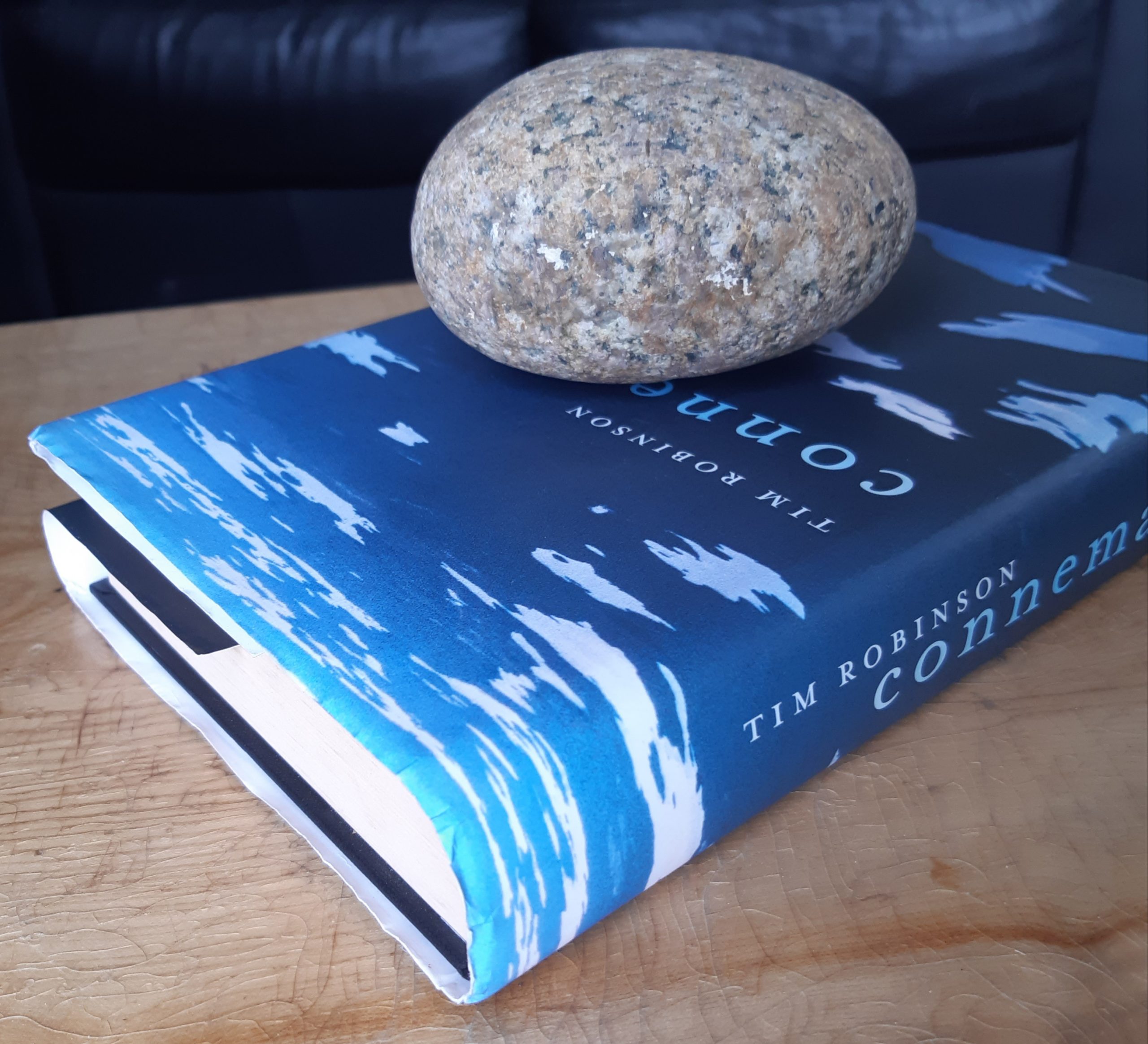
Tim Robinson’s Connemara with a “Connemara stone” from Ballyheigue Beach.
Things happen in threes, so they say.
Cathy Galvin, a poet and journalist whose family emigrated from Mason’s Island in Connemara, contacted me about Charles R. Browne’s ethnographic study of Carna. Cathy also sent me an essay by Kevin T. James on the meaning of “emptiness” in Connemara.
James built his essay around an entry in the visitors’ book of Mongan’s Hotel, the pub/shop/hotel operated by Martin Mongan in Carna in the 1890s. Mongan is an intriguing character and, as usual, I consulted Tim Robinson on Mongan, Mason’s Island, and the tricky issue of the emptiness of Connemara.
I had just begun re-reading Robinson’s Connemara: listening to the wind (first published in 2006) when I went for a walk on Ballyheigue Beach and found several “Connemara Stones” in the intertidal zone, a favourite haunt of Tim Robinson’s. “Connemara Stones” are erratics, granite rocks that were picked up by a glacier in Connemara and carried south until the ice melted and dropped the stones at various sites in Kerry (see the Proceedings of the Geologists’ Association, 119, 2 (2008): 137-152).
Then, TG4 announced the screening on Weds June 10, 2020 of a new film that it is broadcasting in memoryof Tim Robinson and his wife and longtime collaborator Mairéad Robinson. The film explores the Robinsons’ topographical study of Connemara over thirty years.
Tim Robinson’s Connemara: listening to the windis an intriguing book that has at its core an environmentalist’s awareness of the tension between emptiness and settlement over several centuries of social, political, and cultural disruption, a theme that he developed in a series of walks through the landscape.
It will be interesting to see what that looks like on film.
Deirdre McQuillan interviewed Tim on the occasion and quoted his observation that, in Synge’s hands, the camera turns “itself back to front and photographs the artist. Synge’s sitters . . . do not confront the camera, they present themselves to it frankly and trustingly. And that is the stance of Synge himself in relation to the countryfolk he interprets in his own image.’ (The Irish Times)
That statement could apply to Tim himself, but it was the quality of his scholarship and his meticulous rendering of local detail – in his map making and his writing – that made him an indispensable guide to the Aran Islands and Connemara.