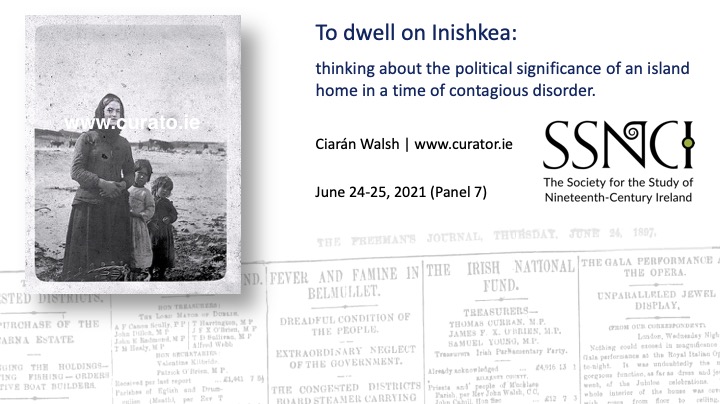
Ciaran Walsh | www.curator.ie returns to the theme of Charles R. Browne, the Irish Headhunter for a disruptive new study of the relationship between anthropology and the political establishment in the 1890 at The Society for the Study of Nineteenth Century Ireland’s(SSNCI) annual conference conference, hosted by the School of History in University College Cork.
The conference explores the idea dwellings in nineteenth-century Ireland and Walsh uses Browne study of dwellings in Mayo in 1894, 1895 and 1896 to explore why an epidemic of typhus on the small island of Inishkea came to play a pivotal role in the escalation from home rule to revolution?
If COVID has taught us anything, Walsh argues, it is that pandemics are political events and the small epidemic in Inishkea was no different. Walsh weaves the politics of anthropology and home rule into an original an disruptive exploration of what it meant to dwell on Inishkea, that is to be an Irish native in an English colony in the 1890s.
Ciarán Walsh’s latest post on RTÉ Brainstorm (14|04|2021) summarises a long campaign to repatriate 24 skulls stolen in 1890 from burial grounds in the west of Ireland by agents of the Anthropological Laboratory in Trinity College, Dublin.
The colonial legacies of universities and museums have become an issue, especially culturally sensitive material like human remains in anthropological collections that were tainted by colonial violence and scientific racism.
Cultural diversity in universities has been pushed to the top of the agenda by the Black Lives Matter movement and TCD has taken the its first steps towards a decolonised campus … maybe.
College authorities are considering renaming the Berkeley Library because Berkeley was a slaver: he enslaved four people on his plantation in Rhode Islands in the 1700s. Decolonising the campus will involve more than renaming a building or two. It may involve dismantling the Anthropological Collection in the ‘Old’ Anatomy Museum in line with international calls for the decolonisation of museums that hold culturally sensitive material.
Alfred Cort Haddon and Andrew Francis Dixon stole thirteen crania from a burial ground on Inishbofin Islands and TCD acquired the skulls in 1892.
The Anthropological Collection in TCD holds 24 crania stolen from burial grounds in the west of Ireland in 1890, making it one of the most culturally sensitive collection in the context of calls for western museums “to return objects looted in the violent days of empire.” (The Guardian).
old tropes & new histories: an “Irish” reading of the Haddon Papers
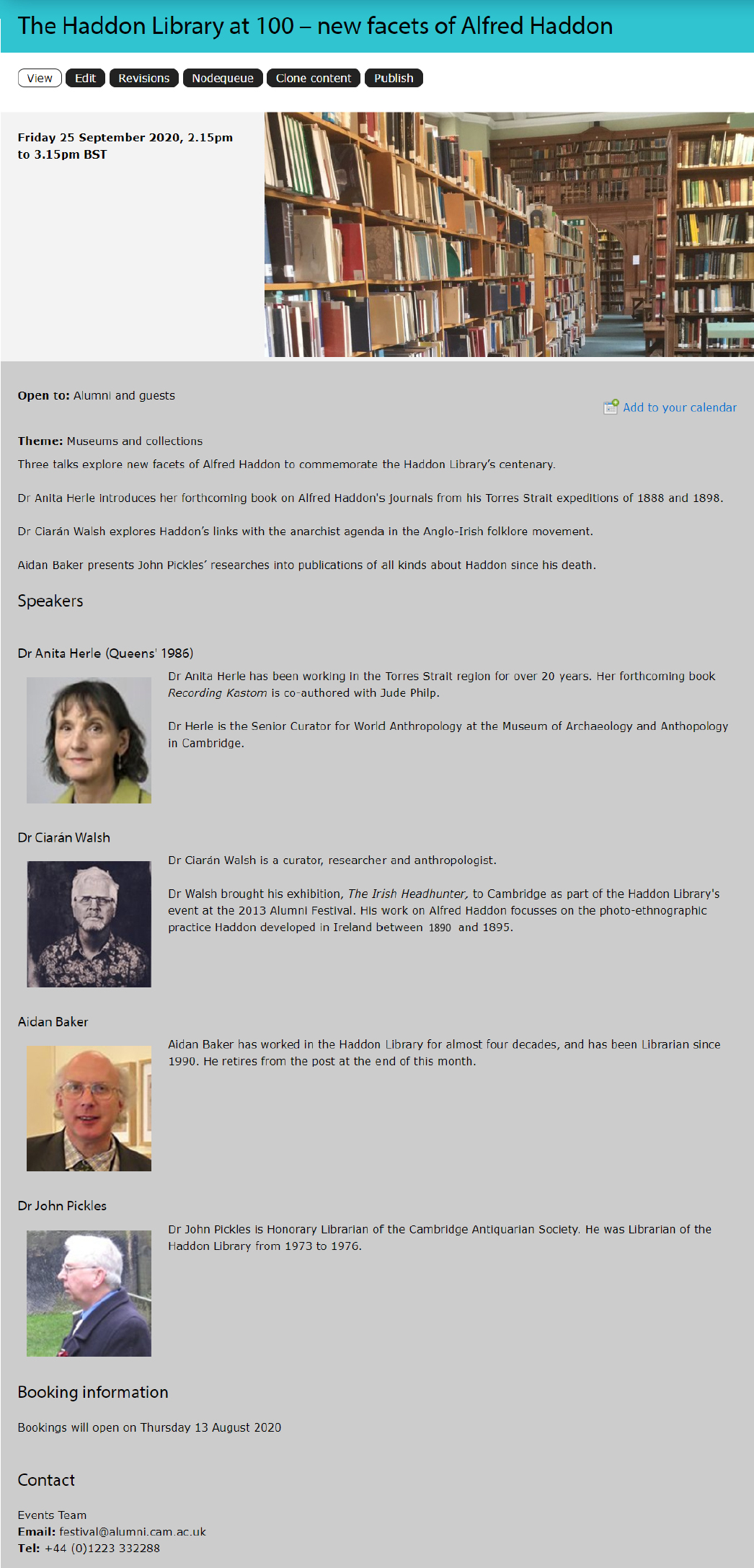
is the theme of a 15 minute presentation by Dr Ciarán Walsh marking the centenary of the establishment of the Haddon Library. The event is part of Cambridge University’sAlumni Festival 2020 and is especially significant given that Walsh’s groundbreaking study of Haddon’s role in anglo-Irish anthropology started at the Alumni Festival in 2013.
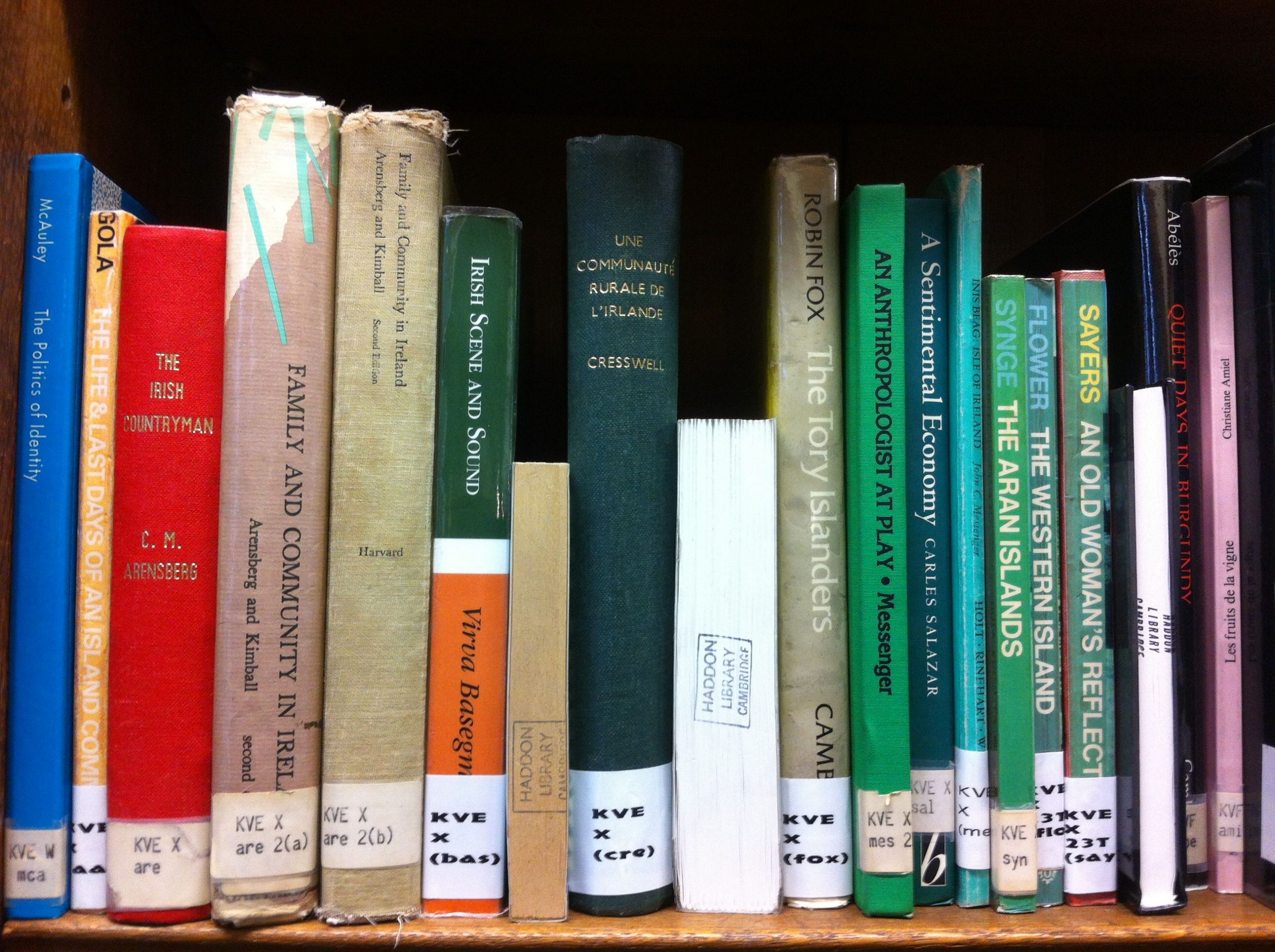
The Irish section of the Haddon Library in 2013
Aidan Baker, the Haddon Librarian, invited Walsh to curate an exhibition of photographs from the Irish Ethnographic Survey as part of Alumni Festival 2013. The photo above captures the low level of interest in Ireland at the time, but, in preparation for the opening, Aidan searched the “locked room” for Haddon’s personal copy of the seminal “Ethnography of the Aran Islands, County Galway”, which the Royal Irish Academy published in 1893. For some reason Haddon didn’t keep a copy, but Aidan found his file on the Aran Islands, which had been ‘missing’ for a century or so.
Aidan Baker, Haddon Librarian, with Haddon’s file on the Aran Islands, which was separated from the main body of his papers in 1913 and found in the Haddon Library in 2013.
That file contained ten pages from a journal that Haddon kept during his first visit to the islands in 1890, a manuscript of a commentary for the ethnographic slideshow that he performed on his return to Dublin, a sketchbook, photographic plates from “Ethnography of the Aran Islands, County Galway,” a map and other documents.
This triggered a sustained reading of the Irish component of the Haddon Papers in Cambridge University Library, guided initially by Dr John Pickles. That began in 2014 and culminated in a radical review of Haddon’s contribution to the development of Anglo-Irish anthropology in the 1890s: a major piece of doctoral research (funded by theIrish Research Council) that has just been completed.,
A small part of that research will be presented in this exploration of new facets of the life and career of Alfred Cord Haddon:
Ciarán Walsh and Nuala Finn “attend” an online awards ceremony during which Maynooth University conferred Walsh with a Doctor of Philosophy (Arts) degree.
Dr Mark Maguire, Dean of Social Sciences at Maynooth University, announcing the award in a video posted on YOUTUBE.
Walsh’s research, funded by the Irish Research Council, uses the scientific study of race in an historical context to create a scientifically robust platform to challenge racism in a contemporary context, creating an interface between academic anthropology and civil society activism by employing a range of public engagement strategies.
It has been widely recognised as an original contribution to the history of anthropology, challenging a long-held consensus that anthropology, as practiced in in Ireland in the 1890s, was a uniformly evolutionist and colonial enterprise. Walsh argues that Haddon was influenced by anarchists and ant-imperialists and developed photography as an instrument of anti-colonial activism, which functions as an analogue of contemporary anti-racism campaigns.
A detail of Haddon’s photograph of Gododo, taken in the Torres Strait in 1888, juxtaposed with a screen grab form Celia Xakriabia’s video calling for an end to “legislated” genocide in the Amazon.
Haddon was primarily a photographer who used the study of folk-lore, art and dance – which he defined in 1895 as the study of the “deepest and most subtle ideas of mankind” – to humanise and socialise anthropology, which was restricted to the anatomical study of the natural history of the human species within the academy.
Haddon operated on an extramural basis, jumping the academic wall and working through a network of folklore and naturalist organisations, becoming an important resource for cultural nationalists in Ireland. This brought him into conflict with the academy, a confrontation that prefigures current debates about the relationship between academic anthropology and anthropologists who operate civic society and humanitarian contexts.
Professor David Prendergast, Dr Ciarán Walsh, and Mark Maguire.
To conclude, Walsh’s study of The Skull Measuring Business represents an original and formally innovative study of the issue of racism in the 1890s, which, 130 years on, has become a defining issue in contemporary Ireland. It also represents a novel contribution to debates about the practice and purpose of anthropology, a debate that is as old as anthropology itself and remains as ‘lively’ as it was during Haddon’s time in Ireland.