Ciarán Walsh begins work on the Ann Doherty Collection in Donegal County Archives Service. Photo: Niamh Brennan, Archivist at Donegal County Council.
Donegal County Council Archives Service acquired a collection of photographs by Ann Doherty in 2018. Doherty worked as a photojournalist with the Sunday Times Magazine between 1998 and 2005 and documented ordinary people living in extraordinary situations across the world. She documented poverty in Blair’s Britain and travelled through post-communist Caucasus countries, Ukraine, and the Balkans. She also worked in Jordan, Egypt, and Sierra Leone. Doherty grew up in England, but her grandmother lived on Gola Island, a small island off the coast of Donegal. This was the subject of her first commission and it remained a major influence on her work as a social documentary photographer.
The Heritage Council awarded Donegal County Archives Service a Heritage Stewardship grant to employ an archivist / curator to work with County Archivist Niamh Brennan and catalogue, digitise, and prepare the collection for exhibition in partnership with Caroline Carr and Judith McCarthy in the County Museum. Ciarán Walsh began work on the project in July, working alongside Niamh Brennan and Ann Doherty on the selection and digitising of 75 images for exhibition. The second phase of the project got underway in August and an exhibition of Doherty’s photographs titled A Common Humanity is scheduled to open in Donegal County Museum in Letterkenny on September 22.
BEROSE International Encyclopaedia of the Histories of Anthropology has commissioned Ciarán Walsh to write a new entry on the life and work of Alfred Cort Haddon (1865 – 1940). The entry draws on independent post-doc research for a ground-breaking reassessment of Haddon’s contribution to the modernisation of anthropology that Berghahn Books commissioned as part of its series on Anthropology’s Ancestors. Alfred Cort Haddon: a very English savage (in Ireland) is due out in 2023 and represents a radical reworking of Haddon’s work as an artist, philosopher, ethnologist and anti-racism activist whose experiments in photo-ethnography cinematography constitute a singularly modernist achievement in anthropology.
The timing couldn’t be better. The photograph above records a seminal moment in the brave new world of practical marine biology which sets the scene for Haddon’s enthusiastic entry into ethnology two years later, an event that was so disruptive it triggered a decade-long battle with anatomists who attempted to restrict academic anthropology to the study of the natural history of the human species in situations defined by theoretical positions compatible with empire and evolution. This scenario has its analogue in the current stand-off between those who see anthropology as an engaged and essentially emancipatory project and those who operate a restricted form of practical anthropology within a neoliberal academy.
As such, the BEROSE entry represents the first part of a new history of anthropology in Ireland. It addresses key themes of the current debate about what it means to do anthropology (to borrow a phrase from Clifford Geertz) in the intertwined contexts of an engagement with colonial legacies sparked by the Black Lives Matter Movement, legislated genocide in the Amazon and other flash-points across the globe, and the restrictions on knowledge production that characterise a neoliberal academy.
BEROSE will publish “Artist, Philosopher, Ethnologist and Activist: The Life and Work of Alfred Cort Haddon (1855-1940)” by Ciarán Walsh in August 2022.
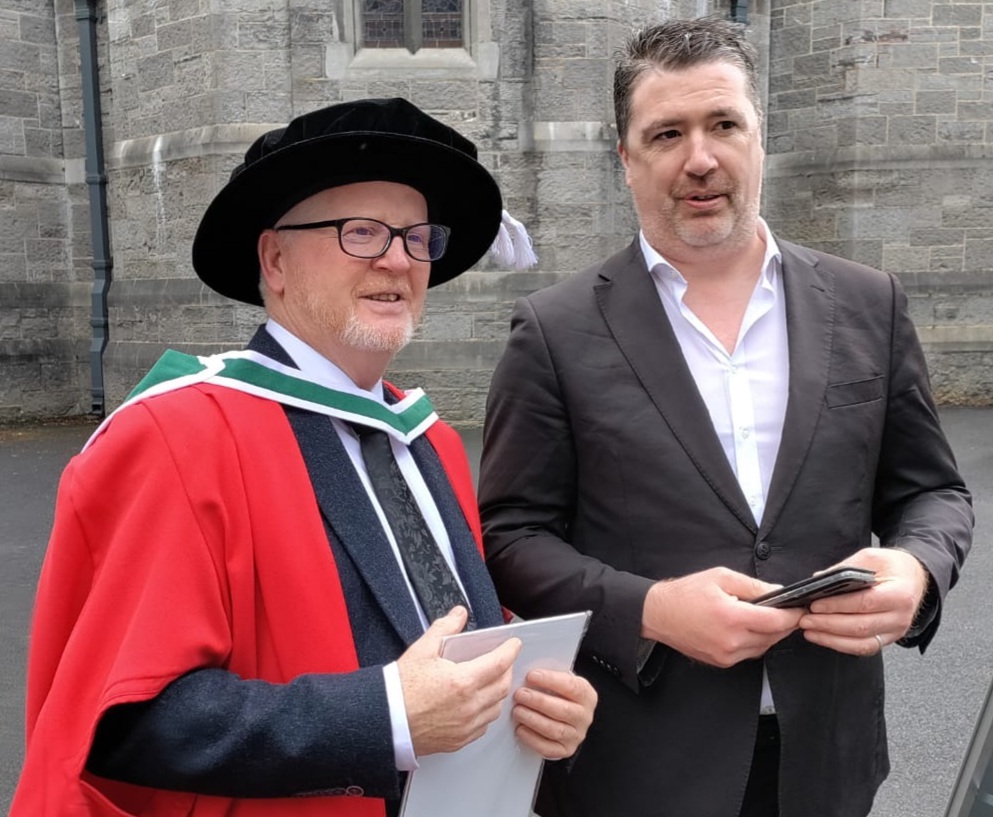
Ciarán Walsh and Mark Maguire, Dean of Social Sciences at Maynooth University after a conferring ceremony in June 2020 .
Mark and I set out on a PhD in 2015, which we both agree was ‘an-archic’ mix of art, politics, and engaged anthropology that tested the limits of the academy. Mark kept it on track and we got got through a viva with the highest distinction in June 2020. Friday was a wrap on the academic side and that marks the start of an exciting new phase the “Head-Hunter” project.
The book has gone to Berghahn Books NY and Dearcán Media’s film ‘Iarsmaí’ is about to go into production for TG4/BBC. It features a campaign to have 24 stolen skulls returned by TCD to communities in the west of Ireland, one of three interwoven stories that relate the consequences of the Black Lives Matter Movement for colonial era institutions Ireland.
Routledge Taylor Francis has just published Folklore and Nation in Britain and Ireland, edited by Carina Hart and Matthew Cheeseman. It’s a multidisciplinary study of the idea of folklore and its relationship to the idea of nationhood, especially in the form of nationalist ideologies. The project developed out a lively conference organised by the Folklore Society and Derby University to coincide with the planned departure of Britain from the EU in March 2019.
Ciarán Walsh takes David Michôd’s 2019 reworking of Sheakespeare’s HenryVas an example of the mobilisation of an imagined nation at a time of crisis and links this idea to the emergence of the English-England movement that led to BREXIT. This becomes the starting point for a radically new look at the the history of folklore collection in Ireland in the 1890s, when Irish nationalists and their anti-imperial allies intensified their efforts to break the union between Ireland and the United Kingdom.
Walsh revisits Haddon’s attempt to mobilise an anti-colonial, Anglo-Irish folklore movement in the 1890s as part of a ‘savage-lives-matter’ campaign that was influenced by utopian, anarchist, and anti-colonial ideas. The centre piece of this argument is Haddon’s photographic collaboration with Clara Patterson, which was part of a wider investigation of dance as a marker of the essential unity of humankind.
Walsh proposes that Haddon’s film represents a singular modernist achievement in the history of folklore/anthropology and wonders why the folklore movement he started – with its commitment to racial and gender equality – has long been eclipsed by Douglas Hyde and his followers who prioritised collection and restoration over critique and revolution?
RTÉ Brainstorm has published “Don’t Kick That Skull” by Ciarán Walsh, the second part of the story of skullsstolen by Haddon and Dixon from community burial grounds in the west of Ireland in the 1890s.
Covid restrictions have forced us all to think about traditions relating to death and dying. The case of skullsstolen on Inishbofin, the Aran Islands, and The Glen (St Finian’s Bay) in 1890 has added a curious twist to that story. The Inishbofin skulls were originally held in a niche in St Colman’s Monastery on the island (see this post on Ballymaclinton) and the current keepers of the skulls, the Anatomy Dept in TCD, have used this fact to raise doubts about the origin of the skulls and contest a claim for the repatriation.
TCD has undertaken an osteo-archaeological investigation into the origin of these skulls and there is no indication as to when those results may be available. In the meantime, Ciarán Walsh completed a separate investigation into burial practices in the west of Ireland in the 1890s and published the finding on the RTÉ Brainstorm site.
“Don’t kick That Skull” reveals a tradition of using sites like St Colman’s Monastery for holding skulls found during burials and reports on a fascinating body of Irish folklore and oral history that warns people against interfering with skulls and human remains found in sites like this. The question now is whether TCD is listening?