Uncategorized

Ciarán Walsh at work on ‘Haddon in Ireland’ in Cambridge University Library. Photo by Ciarán Walsh
Ciarán Walsh / www.curator.ie has been notified by the Irish Research Council that the Employment Based Postgraduate Programme he proposed has been recommended for funding. The programme is being developed in partnership with Maynooth University (Graduate Studies Office and Anthropology) with Abarta Audio Guides of Clonmel as enterprise partners.
The decision of the Irish Research Council means that Ciarán Walsh will shortly be offered funding for a 4 year funded post-grad (PhD) research project which looks at ‘Haddon in Ireland’ and incorporates the development of innovative interactive systems for multi-site archives and heritage sites.
The project will commence in February 2015.
Uncategorized
Taimse Im Chodladh Vimeo(2) from Ciarán Walsh / www.curator.ie on Vimeo.
‘Taimse Im’ Chodladh’ or ‘I am Sleeping’ (2014) was Directed by London based Kerryman and artist Denis Buckley and produced by me for www.curator.ie. It has been nominated for the TG4 Irish language award at the Fingal Film Festival
I am very proud of ‘Táimse im’ Chodladh.’ Emigration is etched into heart and soul of West Kerry, it’s social fabric, landscape and its language. ‘Táimse Im’ Chodladh’ is a synthesis of all of that, realised by Denis Buckley, an artist who has experienced emigration for over thirty years. It was made in Kerry, using local talent and resources to achieve a perfectly compact vision or ‘fís.’
From the outset it was an article of faith that this film be made trí mheán na Gaelinne. The script was translated into Gaelainn or West Kerry Irish by Bríd Criomhthain and Bosco Ó Conchúir and recorded as a soundtrack in the Beehive Theatre, Dingle. Bríd Criomhthain, Naoise Mac Gearailt, Jeaicí Mac Gearailt and Nuala Nic Gearailt performed the parts.
More Information: http://www.curator.ie/?p=3259
Uncategorized
[simpleviewer gallery_id=”87″]
31.08.2014: Ciarán Walsh participates in a 1 day wet plate collodion workshop with Monika Fabijanczyk
In the wet plate collodion process photographs are created on glass or metal plates. The plates are coated and sensitised, exposed in a wet plate camera (or any camera that has been adapted to take a plate glass negative) and processed while they are still wet. Everything has to be done within 15 minutes or so, moving from the darkroom to the camera and back. It is a slow process where everything is made by hand, from preparing the plates and light sensitive material, through to developing, fixing, and varnishing the photographs.
The collodion process produces a negative which, if exposed on a blackened glass plate (an Ambrotype) or a metal plate (a Tintype) is reversed, producing a one-off positive image. This technique creates stunning photographs, the combination of glass and metallic silver against a black background produces intriguing effects in terms of tone and texture.
The workshop was intensive and a little challenging according to Walsh. ”It’s 25 years since I have been in a darkroom but Monika took each of us through the process, calmly and efficiently. Large format (4×5 inches) cameras were used with artificial and natural light to take portrait and still life shots ranging from 7 to 50 second exposures, Some worked, some didn’t but the excitement of seeing an image develop in the darkroom was something I had forgotten all about and it was a tremendous surprise on the day. The complexity of the chemical processes and the speed required to ‘get’ the image before the plate dries or overdevelops really makes one reconsider the work done by Timothy O’Sullivan and other photographers during the American Civil War.”
Highly recommended.
For more information:www.monikafabijanczyk.com
Uncategorized

A photograph of the Great Blasket Island in the 1930s taken by Thomas H. Mason of Dublin. L-R: Domhnall Mharas Eoghan Bháin Ó Conchuir and Pádraig ‘Ceaist’ Ó Catháin.
The definitive exhibition of photographs of life on the Blasket islands opens in St. John’s Theatre in Listowel on Saturday 9 August 2014.
‘An Island Portrait’ has been developed by The Great Blasket Centre and www.curator.ie to accompany the publication by Collins Press of a book of photographs of the Blasket Island. The text was written by Micheál de Mórdha (Director) and Dáithí de Mórdha (Archivist) and the photographs were edited by Ciarán Walsh of ww.curator.ie. The exhibition contains 50 photographs dating from 1892 onwards and it combines classic ‘outsider’ views of the islanders and their way of life with photographs from family albums. The ethnographic look is counterbalanced by personal and, at times, intimate glimpses of family life on the island.

Gearóid Cheaist Ó Catháin, the last child to live on the Great Blasket Island with Dáithí de Mórdha, The Great Blasket Centre, in front of a photograph of Gearóid with his Grandfather Maurice Mhuiris Ó Catháin, taken by Dan MacMonagle after the Island was evacuated in 1953.
Uncategorized

Mark Maguire, Head of Anthropology NUI Maynooth, Ciarán Walsh , Nicola Reynolds, President of thr Anthropological Society NUIM and Steve Coleman, NUIM at the opening of the Headhunter exhibition in NUI Maynooth in October 2013.
A major research proposal prepared by Ciarán Walsh for the Irish Research Council’s (IRC) Employment Based Post-graduate Programme has been endorsed by the National University of Ireland Maynooth (NUIM) and now proceeds to the IRC for evaluation and adjudication. The proposal builds on the work that Walsh has been doing on the ‘Haddon in Ireland Project’ and involves a 4 year post-graduate research project supervised by Mark Maguire of NUIM in partnership with Abarta Audio Guides, a small heritage services company operated by Neil Jackman and Róisín Burke.
Neil Jackman of Abarta Audio Guides: http://abartaaudioguides.com/about-us
The ‘Haddon in Ireland’ research project brings together public research (NUI Maynooth), private sector innovation (Abarta Audio, Clonmel) and a researcher with a proven track record (Ciaran Walsh) to reopen and reexamine the history of human science in the British isles.

This project aims to explore the Irish Ethnographic Survey, an attempt to reveal the origins of the Irish ‘race’ undertaken by scientists from Ireland and the UK between 1891 and 1903. Among them was the famous AC Haddon. This was the beginning of ‘scientific’ Anthropology but it was overshadowed by subsequent developments in Cambridge. The records were ‘lost,’ dispersed over collections in Ireland and the UK where they have remained uncatalogued and largely overlooked for 120 years.
The primary aim to reconstruct that archive and place it in the public domain. The central question is how that can be achieved, given that the material is spread over a dozen institutions in 4 jurisdictions. We will look to the latest interactive technology for solutions.
We propose to create a transnational network that digitally links collections Dublin, Cambridge, London, Edinburgh and Belfast. We will develop interactive tools that will provide access to it and enhance the users experience of our anthropological heritage. The contemporary significance of this is enormous. The Survey’s attempts to trace the origins of the Irish people continues with the genetic study of populations.
This project will reconnect both and the transnational component will add enormously to the impact of the project on the public construction of Anthropological knowledge.
Uncategorized

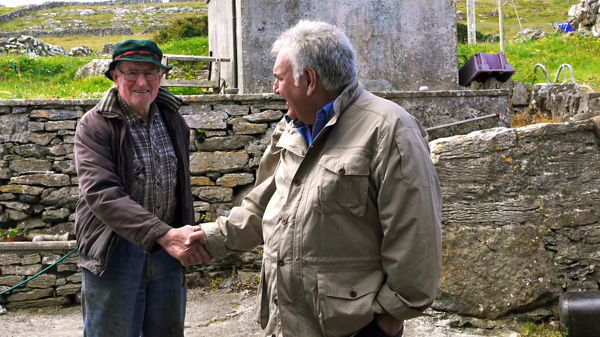
Ruairi and Chris meet after 40 years. Photo by Ciarán Walsh.
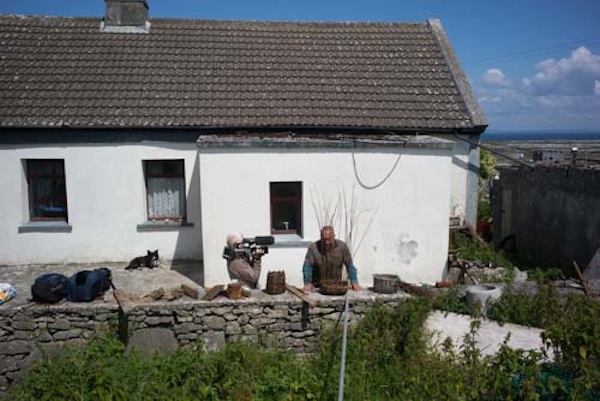
In June 2014 Chris Rodmell and Ciarán Walsh returned to Inis Meáin, the middle island of the Aran Islands, to meet some of the people Chris had filmed there in in 1973. Chris, a student in West Surrey College of Art and Design, had won an award of £250 from Thames Television to film life in an “enclosed community living on one of the remote islands off Ireland or Scotland.” He chose Inis Meáin. He spent three weeks on the island, filming with a 16mm Bolex and taking photographs with a medium format Mamiya on Kodak Ektachrome professional stock.
Info: http://www.curator.ie/inis-meain-1973-exhibition-photographs-chris-rodmell/

Peadar Mór, Ciaran Walsh and Muirís Mac Chonaola on Inis Meáin. Photo by Chris Rodmell.

Filming Peadar Mór at work weaving a basket. Photo by Chris Rodmell.