Uncategorized

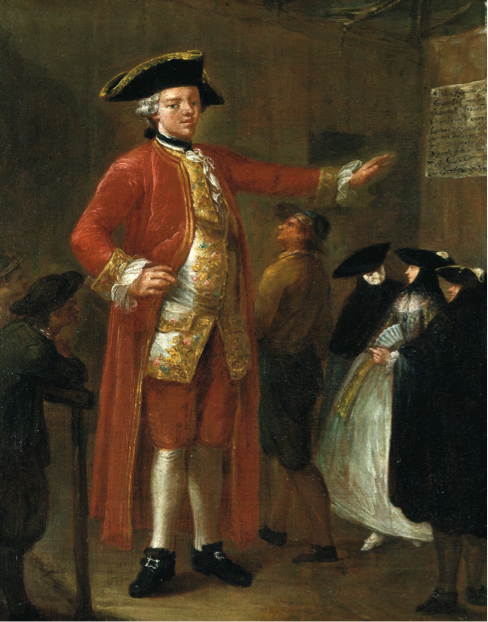
Pietro Longhi, 1757, “True portrait of the Giant Cornelio Magrat the Irishman; he came to Venice in the year 1757; born 1st January 1737, he is 7 feet tall and weighs 420 pounds. Painted on commission from the Noble Gentleman Giovanni Grimani dei Servi, Patrician of Venice.” Museo di Rezzonico, Venice. Photograph: Osvaldo Böhm.
The Skeleton of The Irish Giant, Cornelius Magrath is held by the School of Anatomy in Dublin University, Trinity College (TCD). It is the most famous item in a historic collection of anatomy specimens, records, and instruments that is held in the ‘Old’ Anatomy Building. The building was decommissioned in 2014 and the collection is being resolved as part of post-grad research programme managed jointly by the School of Medicine TCD, Maynooth University, Kimmage Development Studies Centre, and funded by the Irish Research Council (IRC).
I am employed as a full-time researcher on the project and resolving ethical issues relating to the retention of human remains is a major part of the work in hand. Indeed, the research proposal had to pass rigorous ethical approval procedures in Maynooth University, the School of Medicine TCD, and the IRC before I could get access to the ‘old’ Anatomy building and the collections held therein, which include the skeleton of Cornelius Magrath.
The skeleton is “in the news” following calls for Magrath’s remains to be buried. The controversy kicked off on the History Show on RTE Radio 1. It was picked up by chat show host Joe Duffy on Monday. Duffy argued that TCD should bury the skeleton of Cornelius Magrath because it was taken in a ‘body snatching’ raid on Magrath’s wake. Since then a debate of sorts has been taking place on the show.
The problem here is that there is no evidence that the body snatching story, however entertaining, is true. Magrath died on 16th May 1760 but the only contemporary account of his death was most likely written by either Robert Robinson, Professor of Anatomy in TCD, or Dr. George Cleghorn, the University anatomist. It is a rather enigmatic account, stating only that “Upon death, his body was carried to the Dissecting House.” (see Daniel J. Cunningham’s 1891 report to the Royal Irish Academy).
Magrath was dying of a wasting disease and it is clear from the Robinson/Cleghorn account that he was receiving medical attention at the time of his death. It records that Magrath’s “complexion was miserably pale and sallow; his pulses very quick at times for a man of his extraordinary height; and his legs were swollen.” Elsewhere, it states that his pulse beat almost sixty times a minutes “on his arrival here.” It sounds like Magrath was being cared for in the School of Medicine TCD when he died.
The body snatching legend has it that Magrath was being waked when medical students spiked the porter and made off with his body, which was immediately dissected in secret. Such a sensational body snatching could not have escaped notice and, furthermore, the dissection was both public knowledge and uncontroversial. Historians of anatomy in TCD have always believed that the body was paid for by Cleghorn and that the acquisition of the body was legitimate and ethical by the standards of the day. The problem here is that there is no documentary evidence of Magrath having consented to dissection or the permanent display of his skeleton.
That brings us to the contemporary issue of retention or burial. The report of the Working Group on Human Remains in Museum Collections (WGHR), published in the UK in 2003, acknowledged that human remains in collections “represent a unique and irreplaceable resource for the legitimate pursuance of scientific and other research” (p. 28) and concludes: “The Working Group feels that there is much merit in including museum collections of human remains within the regulatory structure proposed by the DH for health authorities and hospitals.” (p. 81).
Supervision by the Inspector of Anatomy of the ‘Old’ Anatomy collections in TCD covers the issue of regulation in Ireland in terms of the retention of Magrath’s skeleton as part of a historical scientific collection. This leaves the burial of Magrath’s remains at the discretion of the college authorities; which means that any decision will have to deal with public perception as to the “morality” of retaining identifiable human remains in collections of scientific material. That is deeply problematic, and Duffy’s attempt to frame the issue in body snatching folklore is distorting what should be a valuable and timely debate.
For more see: http://wp.me/p56Bmf-eP
Uncategorized
 Купля-продажа товаров
Jane W. Shackleton’s singular contribution to the Gaelic Revival has been seriously undervalued. Ciarán Walsh takes another look at the work of this pioneering photographer. In his latest post on the Ballymaclinton blog Walsh questions why Shackleton’s career as a pioneer of social documentary photography been seriously undervalued.
Uncategorized
mensclub24
About 10 years go I came across this photograph. The caption suggests that it was taken during the Famine of 1845-9 in Ireland. It wasn’t. True, it is very similar to the scenes recorded in cabins throughout the west of Ireland and graphic illustrations of such scenes were published in illustrated newspapers at the time. There is no record, however, of any photograph of people dying of starvation in the 1845-9 famine. Indeed a photograph like this would have been impossible in the early stages of photography – invented less than a decade before the famine. As a result he photograph has been dismissed by some people as a fake, the harsh pool of light suggesting a studio staging.
I set out to look for the original and test its authenticity. I never found it, but I found the next best thing – the original document in which the photograph was first published. The photograph is entitled ‘A Sick Family Carraroe’ and is one of 18 photographs that were published in a pamphlet entitled ‘Relief of Distress in the West and South of Ireland, 1898.’ The photographs were taken in April during an inspection of conditions in Connemara by Thomas L. Esmonde, Inspector of the Manchester Committee. He was reacting to reports of famine in Connemara, what locals call the Second Famine or Gorta Beag. He inspected a dozen houses in which he found people lying on the floor, covered with rags and old sacks and barely able to move from a combination of influenza and hunger.
The search for the photograph became the basis of an idea for a TV series on social documentary photography or, to put it another way, a social history of documentary photography in Ireland in the 19th century. I pitched the idea to a producer and a broadcaster in 2011 and funding was eventually secured from the Broadcasting Authority of Ireland in 2014 for a six part series based on my research. TG4 will begin broadcasting Trid an Lionsa or ‘Through the Lens’ tomorrow Sunday 25 October 2015.
I haven’t been involved in in the production itself, just the research into historical social documentary photography and the people who work in this area. This material has been “translated into television” by Cathal Watters (Oíche na Gaoithe Móire) and follows the TG4 controversial format of presenter driven, on-the-road info-tainment. (http://wp.me/p56Bmf-5g).
I have no idea what to expect. Like a colleague I will be watching from behind the couch … hoping! It’ll be interesting to see how the balance between a social history of documentary photography and ‘factual’ entertainment works out. I know some key “voices” were excluded but that is the unenviable task of a producer. Either way it promises be an intriguing televisual event and, at the very least, it should create an awareness of the rich resource that exists in photographic archives and collections around the country.
For more images / Comment see: Ballymaclinton, The Town that Time Forgot
Uncategorized

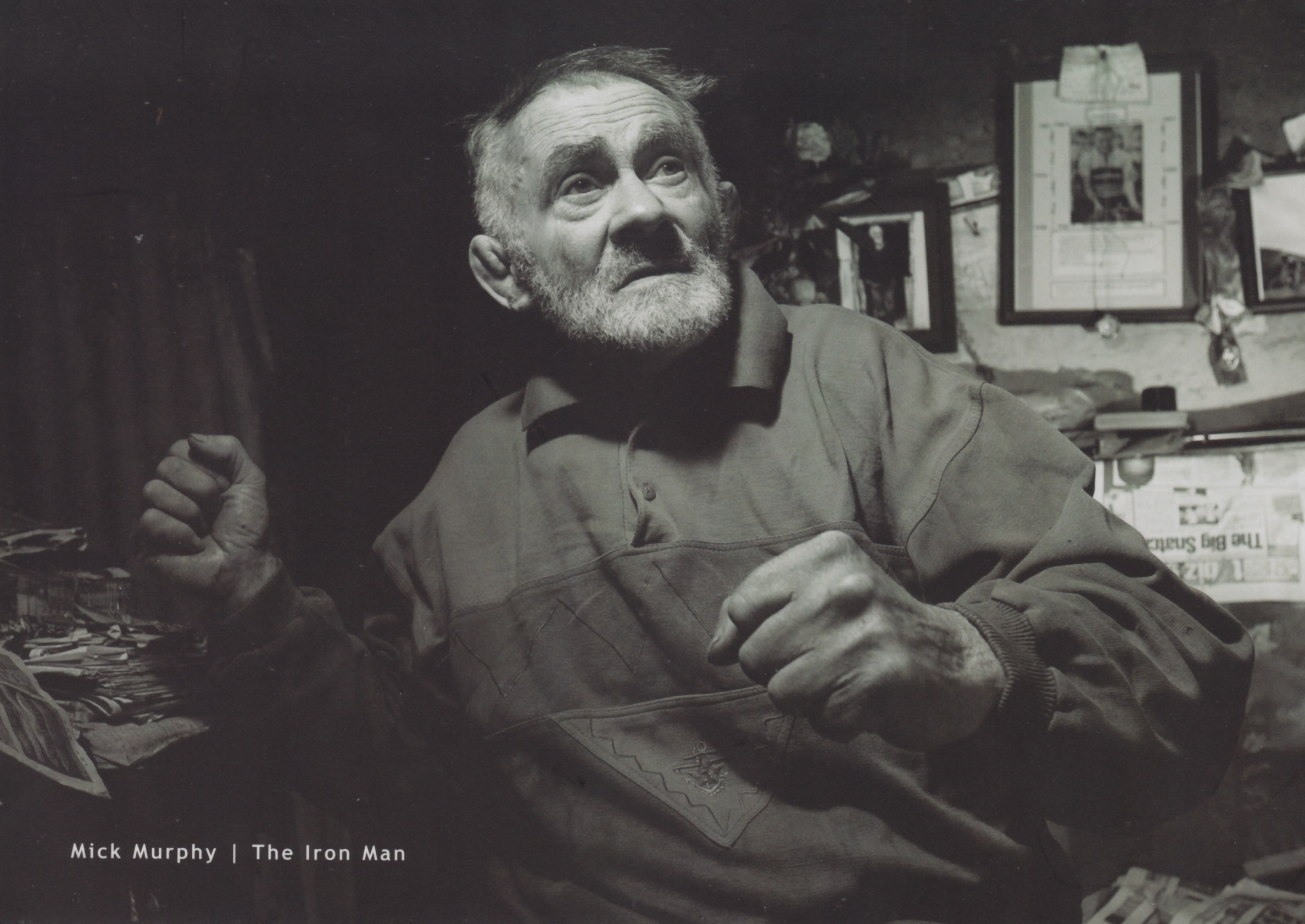
Mick ‘The Iron Man’ Murphy by Barry McCarthy from the exhibition ‘Blood, Sweat and Gears,’ 2008.
I have just learned of the death of Mick Murphy of Cahersiveen in Co. Kerry. Mick was known fondly as ‘The Iron Man’ because of his exploits in a celebrated bicycle race in 1958. Aidan O’Connor, writing in The Kerryman newspaper described Mick’s extraordinary Life:
Mick made a living as a spalpeen and a circus performer. After winning the 1958 Rás, Mick returned to Kerry to work in local quarry, breaking stones with a crowbar and sledge hammer. All the while, the Iron Man was completing daily training routines of 100-mile cycles.
Aged just 27 years, Mick Murphy retired and took the boat to England where he worked as a builder, road maker, a carnival act, boxer and a wrestler.
Mick’s training was as unconventional as his lifestyle. Having read about the important of a high protein diet, Mick drank cow’s blood and ate raw meat, well aware that this was regarded with “horror” by the people of Cahersiveen. The legend that was the ‘Iron Man’ was the starting point for an exhibition that celebrated the 50th anniversary of his victory in the Rás in 1958. The exhibition consisted of still photography by Barry McCarthy interviews recorded by film maker Chris Hurley. The impact of that exhibition is captured in Sean Mac an tSithig’s report (above) which was recorded for the main evening news.
Mick Murphy was one of the most remarkable people I worked with in Siamsa, a true folk hero. Following the broadcast of Seán’s film a lot of men who had gone through similar experiences came to the gallery and spoke movingly of their lives as emigrants and their love of cycling.
Ar dheis Dé go raibh a anam.
Uncategorized

A patchwork quilt by Breda Browne which is on show as part of the Ciar Quilters annual show in Kerry County Museum, Tralee.
Patchwork and quilting are important craft traditions in rural Ireland. Muckross House hold a number of quilts that a well over a hundred years old, rough cotton sheets and flour bags died with madder and quilted with fleece. Ciar Quilters keep that tradition alive as well as experimenting with contemporary techniques, a perfect match of art and craft.
Ciarán Walsh has been working with them for years, hanging an annual exhibition that showcases the work of women quilters from Kerry. The 2015 show has just opened in Kerry County Museum in Tralee and runs until October 1. It is an important part of the Museum’s programme for Culture Night, which takes place on Friday 18 September 2015: a great night in the museum!

This photograph shows a general shot of the Ciar Quilters annual show in Kerry County Museum, Tralee. The exhibition was hung by Ciarán Walsh of curator.ie for Culture Night 2015