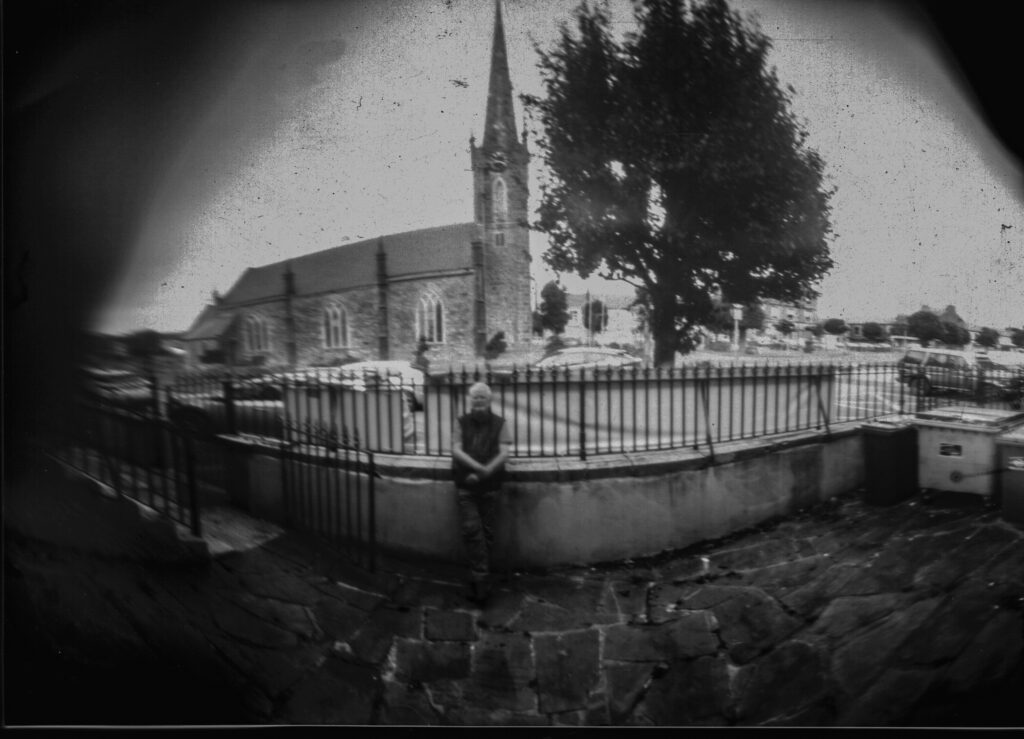
positive scan of black and white pinhole photograph (12 second exposure) showing a curator Ciarán Walsh standing against the wall of Kerry Writers' Museum with St John.s Theatre and Culture Centre - a repurposed church - in the background. The photo was taken through the aperture of a camera obscura using photographic paper wrapped around the inside of a cylindrical coffee tin hence the extreme curve or fisheye effect. Taken during a two-day workshop led by Cork-based artist Harry Moore as part of an analogue mini-fest Ciarán Walsh curated during Heritage Week 2025.


Ciarán Walsh took this photograph with a pinhole camera during a workshop led by Cork-based artist Harry Moore. The workshop was part of an analogue film and photography mini-fest that Walsh curated for Heritage Week 2025. Inspired by Louis Daguerre’s Boulevard du Temple, Paris, 3rd arrondissement (1838?), Walsh posed for 12 seconds against the wall of Kerry Writers’ Museum with St John.s Theatre and Culture Centre – a repurposed church – in the background. The long exposure prevented anything in motion being caught on the photographic media inside the camera. Although, this was far quicker than the 4 to 5 minutes Daguerre needed, the effect was the same – time stands still.
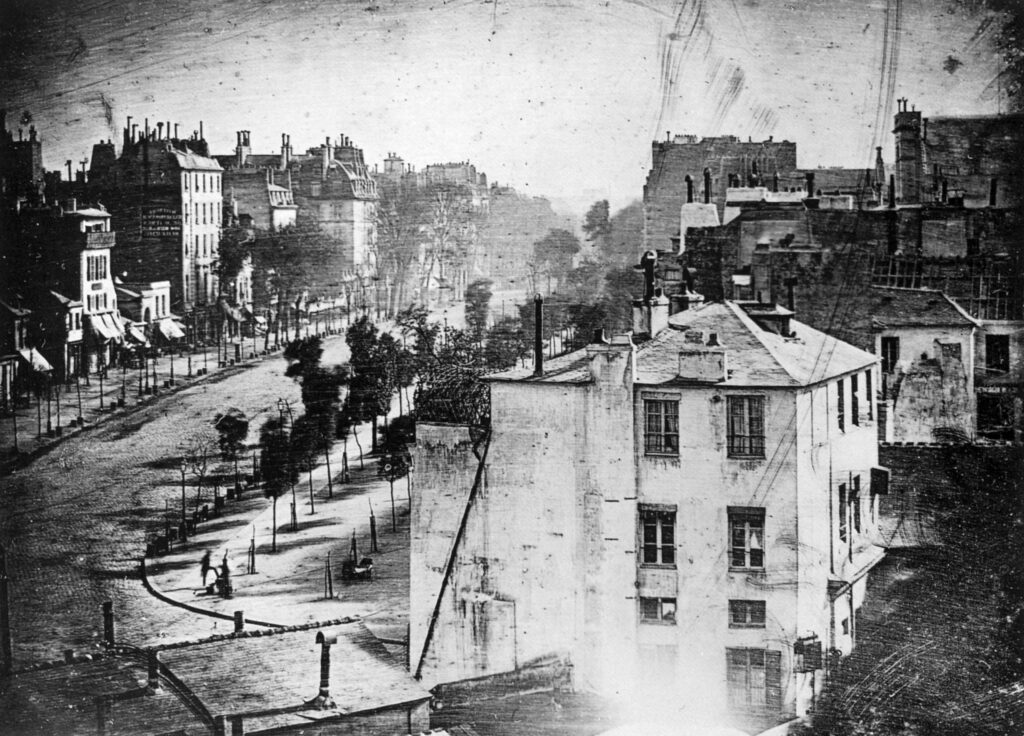
 

Louis Daguerre, 'Boulevard du Temple, Paris, 3rd arrondissement', Daguerreotype. Made in 1837 or 1838, this photograph is believed to be the earliest photograph that captured a living person. Shot from a roof, It captures a busy street in Paris, but because the exposure lasted for 4 to 5 minutes, anything moving traffic left no trace. Only the two men near the bottom left corner, one apparently having his boots polished by the other, stayed in one place long enough to be visible.